- Associate degrees
- Bachelor’s degrees
- Master’s degrees
- Cybersecurity certifications
- Wisconsin Cybersecurity Initiatives
- FAQs
If you’re searching for a cybersecurity degree in Wisconsin, this guide focuses on in-state cybersecurity schools and cybersecurity programs, plus the workforce signals that matter when you’re choosing between certificate, associate, bachelor’s, and graduate pathways.
How we keep this page current
We update this page using workforce demand signals from CyberSeek and wage data from the Bureau of Labor Statistics. We also prioritize official Wisconsin sources for statewide cybersecurity initiatives and public-sector programs.
Ad
cybersecurityguide.org is an advertising-supported site. Clicking in this box will show you programs related to your search from schools that compensate us. This compensation does not influence our school rankings, resource guides, or other information published on this site.
Featured Cybersecurity Degree Programs
| School Name | Program | More Info |
|---|---|---|
| Purdue Global | Online BS in Cybersecurity | website |
| Southern New Hampshire University | Online BS in Cybersecurity or Online MS in Cybersecurity | website |
| UC Berkeley School of Information | Master’s in Cybersecurity | No GRE/GMAT Required | website |
| Arizona State University | Online MA in Global Security - Cybersecurity | website |
| Grand Canyon University | Online BS in Cybersecurity or Online MS in Cybersecurity | website |
Cybersecurity workforce demand in Wisconsin
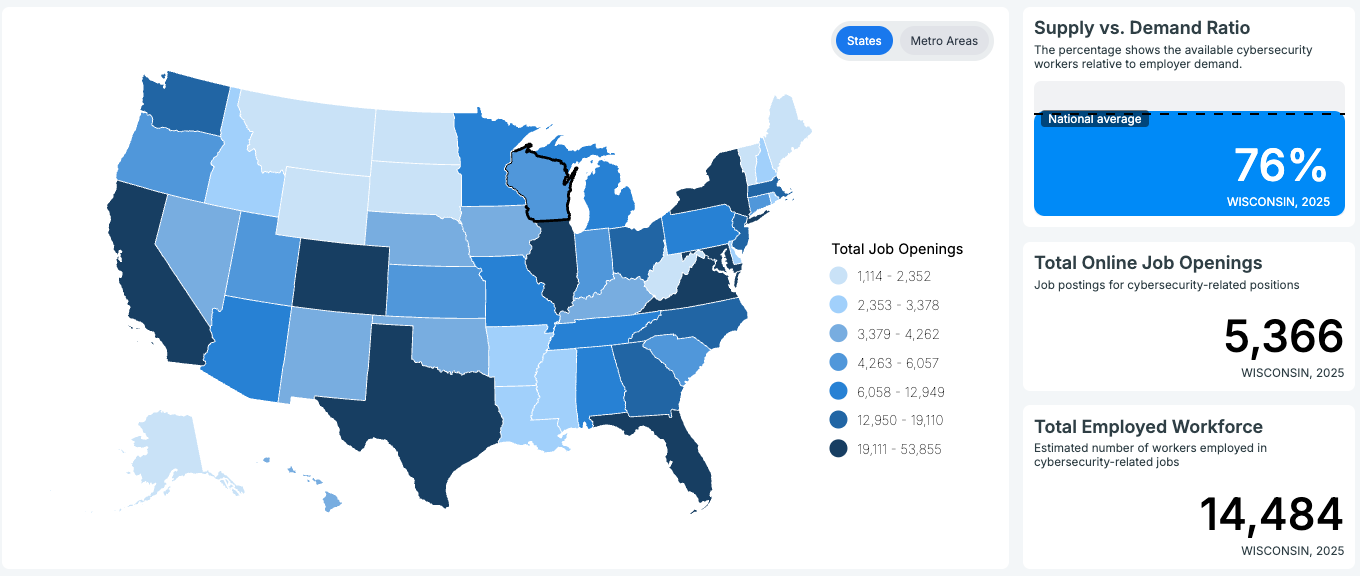
CyberSeek publishes a state-by-state heatmap showing cybersecurity job openings and the employed workforce over a defined 12-month period. For the CyberSeek heatmap period of May 2023 through April 2024, Cybersecurity Guide’s Wisconsin snapshot reports:
- employed cybersecurity workforce in Wisconsin: 14,484
- cybersecurity job openings in Wisconsin: 5,366
These figures are useful for understanding relative demand, but they should be treated as time-bounded to the heatmap’s measurement window.
For wages, BLS 2024 wage data shows information security analysts in Wisconsin earn an average annual wage of $99,210.
Cybersecurity degree pathways in Wisconsin
This section focuses on how to select a cybersecurity program in Wisconsin, rather than offering generic job-board advice.
Associate degrees
An associate degree is typically the fastest on-ramp into entry-level roles (or into a bachelor’s completion pathway). In Wisconsin, many associate-level cybersecurity and networking programs run through the Wisconsin Technical College System.
When evaluating an associate pathway, look for:
- hands-on lab work (networks, operating systems, scripting, security fundamentals)
- alignment with common entry certifications (for example, Security+)
- articulation/transfer pathways into bachelor’s programs
Fox Valley Technical College
Appleton, Wisconsin Program: Associate of Applied Science – Cybersecurity Specialist
Credits: 61
Cost per credit: $189 in state | $283 out of state
Delivery Method: Campus
Learn more: Program detailsNortheast Wisconsin Technical College
Green Bay, WisconsinProgram: Associate Degree in Cybersecurity
Credits: 63
Cost per credit: $163 in state | $236 out of state
Delivery Method: Campus, Online
Learn more: Program details
Bachelor’s degrees
A bachelor’s degree remains a common baseline credential for many cybersecurity roles. Look for programs that provide:
- systems and network foundations (not just policy)
- opportunities for internships or cooperative education
- applied security work (secure coding, incident response, cloud fundamentals)
Because “cybersecurity programs in Wisconsin” change over time, confirm current program rosters directly with the relevant institution or statewide systems before you apply.
Online bachelor’s degrees
Herzing University
Menomonee Falls, WisconsinProgram: Online Cybersecurity Degree – Bachelor’s program
Credits: 120
Cost per credit: $473
Delivery Method: Online
Learn more: Program details
Master’s degrees
A master’s degree can be most valuable when it:
- connects students to internships or government-facing work (where relevant)
- adds specialization (for example, security engineering, governance/risk/compliance, or digital forensics)
- ties to research, applied labs, or workforce partnerships
University of Wisconsin-Green Bay
Green Bay, WisconsinProgram: Master of Science in Cybersecurity
Credits: 34
Cost per credit: $850
Delivery Method: Online
GRE/GMAT Required: Not Required
Learn more: Program detailsUniversity of Wisconsin-Whitewater
Whitewater, WisconsinProgram: Online Master of Science in Cybersecurity
CAE designation: CAE-CD
Credits: 30
Cost per credit: $678
Delivery Method: Online
GRE/GMAT Required: Required
Learn more: Program details
Certifications and workforce programs
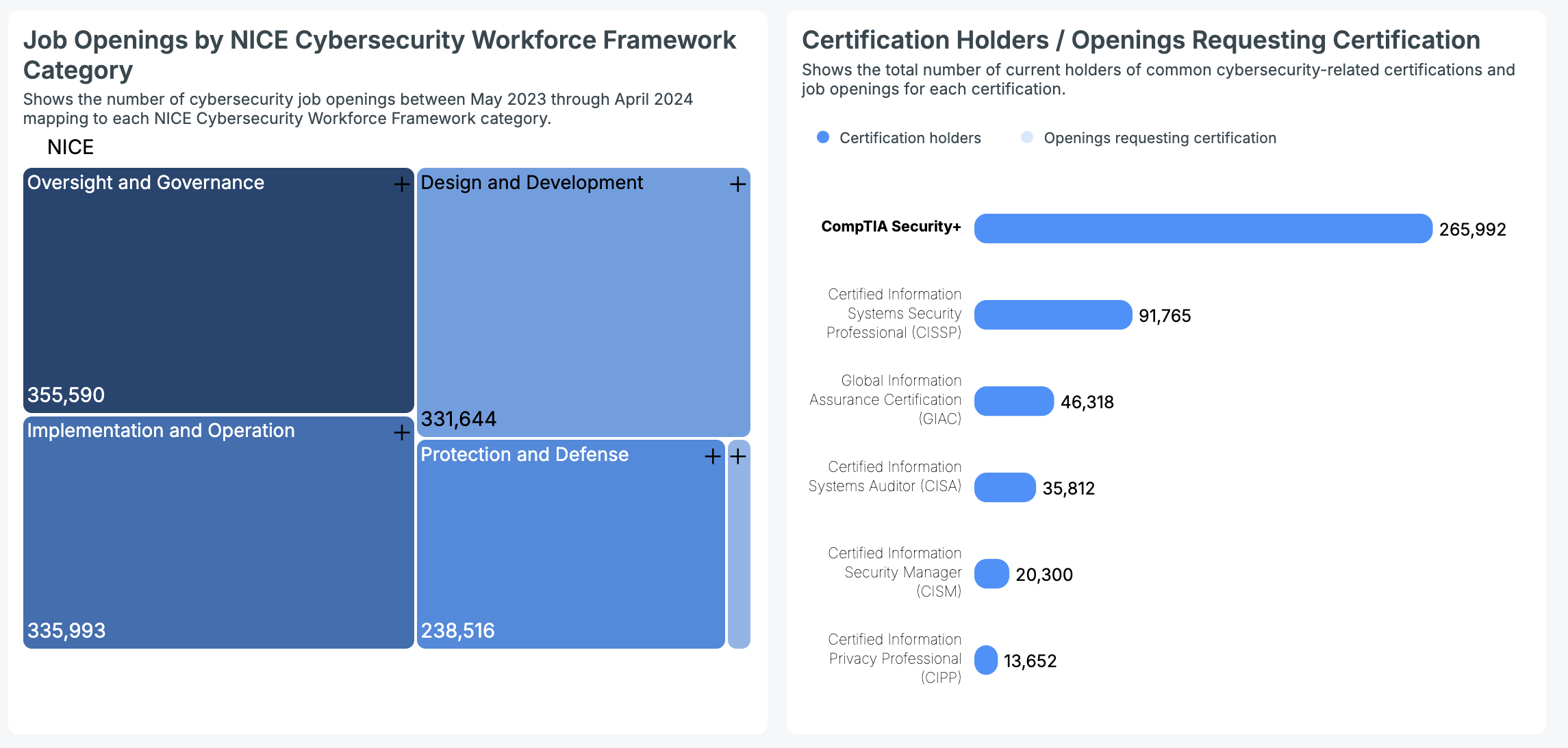
Certifications can complement a degree, especially when paired with labs and projects. CyberSeek’s heatmap includes a section tracking certification holders and job postings requesting certifications at the national level.
For Wisconsin-specific training and public-facing resources, the state’s Division of Enterprise Technology (DET) publishes cybersecurity guidance and planning materials that can help students understand the public-sector security environment.
Campus-based certification programs
University of Wisconsin-Parkside
Kenosha, WisconsinProgram: Cyber Security Certificate
Credits: 9
Cost per credit: $1,022 in-state | $2,088 out of state
Delivery Method: Campus
Learn more: Program details
Online certification programs
University of Wisconsin-Whitewater
Whitewater, WisconsinProgram: Graduate certificate in Cybersecurity
CAE designation: CAE-CD
Credits: 12
Cost per credit: $678
Delivery Method: Online
Learn more: Program details
Scholarship for Service (CyberCorps) in Wisconsin
CyberCorps: Scholarship for Service (SFS) is a federal scholarship program (supported by NSF and administered through an interagency partnership) that funds cybersecurity education in exchange for government service after graduation.
For Wisconsin, the official SFS participating institutions list includes:
- Marquette University (CyberWIN)
Program details (eligibility, covered costs, service obligation) should be confirmed directly with the institution’s SFS program page.
Unique state cybersecurity initiatives
State cybersecurity posture and planning
Wisconsin’s Division of Enterprise Technology (DET) describes its cybersecurity mission and publishes statewide planning materials, including a Wisconsin Cybersecurity Plan that references coordination and information-sharing activities across government and partners.
Incident response and coordination resources
CISA hosts a page for the Wisconsin Cyber Response Team with basic reporting and membership guidance for information sharing.
Election security training and guidance
Wisconsin election officials have implemented cybersecurity-focused training efforts, including “Securing WisVote,” which the U.S. Election Assistance Commission has highlighted as a targeted cybersecurity training program for election officials.
Professional community and events
CypherCon is a Wisconsin-based security and hacker conference with workshops and programming. For 2026, CypherCon lists dates of April 1–2, 2026.
Frequently asked questions about cybersecurity degrees in Wisconsin
For the CyberSeek heatmap period of May 2023 through April 2024, Cybersecurity Guide’s Wisconsin snapshot lists 5,366 cybersecurity job openings in the state.
For the same CyberSeek heatmap window (May 2023–April 2024), the Wisconsin snapshot lists 14,484 employed cybersecurity professionals.
For information security analysts (a common benchmark occupation), BLS 2024 wage data shows an average annual wage of $99,210 in Wisconsin.
CyberSeek’s heatmap snapshot shows thousands of annual openings in Wisconsin during its measured 12-month period, which is consistent with sustained employer demand.
“Best” depends on your target role and timeline. As a rule: an associate degree is often the fastest entry point; a bachelor’s degree is the most broadly portable credential; and a master’s can be most useful for specialization or advancement. Use Wisconsin’s demand and wage signals (CyberSeek and BLS) as a reality check while you compare curricula and hands-on training opportunities.
Yes, but availability changes frequently. Confirm current online offerings directly with each institution (or statewide systems) before applying. This page avoids claiming “only X online programs exist” because that becomes outdated quickly.
Often, yes. Many students use associate-level coursework as a stepping stone, then transfer into a bachelor’s program. To make this efficient, look for explicit articulation/transfer pathways and confirm credit transfer policies with the receiving institution.
Typical timelines:
– Associate degree: about two years full-time
– Bachelor’s degree: about four years full-time (less if you transfer credits)
– Master’s degree: commonly 1–2 years, depending on prerequisites and format
Bootcamps and short-term programs do exist, but they change providers and formats frequently. If you’re considering one, prioritize programs with transparent outcomes, hands-on projects, and employer connections, and verify that the program is currently offered before enrolling.
CyberSeek tracks certifications requested in job postings and the number of certification holders (reported within the heatmap’s certification section). Commonly requested certifications often include Security+ and CISSP, depending on role level, but you should validate against current postings for your target role.
Public-sector organizations (state cybersecurity functions and election security), healthcare and health IT, manufacturing, finance/insurance, and education all have cybersecurity needs. Wisconsin’s DET cybersecurity planning materials and election-security training programs are two examples of public-sector demand signals.
Yes. The official SFS participating institutions list includes Marquette University in Wisconsin (CyberWIN).
Start with the Wisconsin Division of Enterprise Technology’s cybersecurity page and the Wisconsin Cybersecurity Plan for statewide context, and CISA’s Wisconsin Cyber Response Team page for incident-response pointers and information sharing.
Sources
- CyberSeek | Cybersecurity supply/demand heat map | Accessed February 17, 2026
- Cybersecurity Guide | Cybersecurity Degree Programs in Wisconsin Sep. 9, 2025 | Accessed February 17, 2026
- BLS wage data (via O*NET Online) | Wisconsin 2024 wages: Information Security Analysts | Accessed February 17, 2026
- Wisconsin Division of Enterprise Technology (DET) | DET cybersecurity resources page | Accessed February 17, 2026
- Wisconsin Division of Enterprise Technology (DET) | Wisconsin Cybersecurity Plan | Accessed February 17, 2026
- U.S. Election Assistance Commission | Targeted cybersecurity training for Wisconsin election officials | Accessed February 17, 2026
- CISA | Wisconsin Cyber Response Team | Accessed February 17, 2026
- OPM (SFS) | CyberCorps: Scholarship for Service participating institutions | Accessed February 17, 2026
- Marquette University | CyberWIN | Accessed February 17, 2026
- CypherCon | CypherCon 2026 schedule page | Accessed February 17, 2026