- 2026 Rankings
- Associate degrees
- Bachelor’s degrees
- Master’s degrees
- Cybersecurity initiatives in NY
- FAQs
Students researching cybersecurity education options in New York can find a range of college pathways tied to employer demand in finance, defense contracting, insurance, and healthcare.
This page is narrowly focused on degree and school pathways and references institutions only when they support distinctive workforce development, research, or hands-on training opportunities.
How we keep this page current
This content is reviewed using labor market data and program verification from CyberSeek, the U.S. Bureau of Labor Statistics, the New York State Department of Labor, the New York State Office of Information Technology Services, and official university pages for any institution-specific claims.
Program references are verified against institutional or state pages, and time-sensitive claims are updated or removed when newer labor-market or program data becomes available.
Ad
cybersecurityguide.org is an advertising-supported site. Clicking in this box will show you programs related to your search from schools that compensate us. This compensation does not influence our school rankings, resource guides, or other information published on this site.
Featured Cybersecurity Degree Programs
| School Name | Program | More Info |
|---|---|---|
| Southern New Hampshire University | BS in Cybersecurity or MS in Cybersecurity | website |
| Syracuse University | Bachelors in Cybersecurity Administration | website |
| Pace University | Online MS in Cybersecurity | website |
| Fairfield University | Online MS in Cybersecurity | website |
| Purdue Global | Online BS in Cybersecurity | website |
| UC Berkeley School of Information | Master’s in Cybersecurity | No GRE/GMAT Required | website |
Best Cybersecurity Master’s Programs in New York
Across the 69 programs we track, the median cost is $895 per credit and $39,450 in total tuition. 17 programs cost under $20,000 in total. 20 of the 22 programs that report an admissions policy don't require the GRE, and 32 hold an NSA Center of Academic Excellence (CAE) designation. Our top 10 have a median of $1,002 per credit, and 1 of them are fully online. Prices are tuition only and don't include fees. Data last verified . Master of Science in Cybersecurity and Network Administration Cybersecurity, M.S. Master of Science in Cybersecurity Cybersecurity (M.S.) Engineering Science (Cybersecurity) MS Cybersecurity (MS) M.S. Cybersecurity Cybersecurity, M.S. Cybersecurity MSTouro University
Ranking factors
How it does on the ranking factors we track
New York Institute of Technology
Ranking factors
How it does on the ranking factors we track
Yeshiva University
Ranking factors
How it does on the ranking factors we track
Utica University
Ranking factors
How it does on the ranking factors we track
University at Buffalo
Ranking factors
How it does on the ranking factors we track
SUNY Polytechnic Institute
Ranking factors
How it does on the ranking factors we track
Mercy University
Ranking factors
How it does on the ranking factors we track
New York University
Ranking factors
How it does on the ranking factors we track
Rochester Institute of Technology
Ranking factors
How it does on the ranking factors we track
Best Cybersecurity Bachelor’s Programs in New York
Across the 69 programs we track, the median cost is $895 per credit and $39,450 in total tuition. 17 programs cost under $20,000 in total. 20 of the 22 programs that report an admissions policy don't require the GRE, and 32 hold an NSA Center of Academic Excellence (CAE) designation. Our top 5 have a median of $475 per credit, and 1 of them are fully online. Prices are tuition only and don't include fees. Data last verified . BS Cybersecurity Cybersecurity, BS B.S. in Cybersecurity Bachelor of Science in CybersecurityUtica University
Ranking factors
How it does on the ranking factors we track
Pace University
Ranking factors
How it does on the ranking factors we track
SUNY Polytechnic Institute
Ranking factors
How it does on the ranking factors we track
Rochester Institute of Technology
Ranking factors
How it does on the ranking factors we track
These rankings were compiled from data accessed in March 2026 from the Integrated Post-Secondary Education Data System (IPEDS) and College Navigator (both services National Center for Education Statistics). Tuition data was pulled from individual university websites and is current as of March 2026.
Cybersecurity workforce demand in New York
Cybersecurity demand in New York is strong by both postings-based and employment-based measures. CyberSeek’s heat map tracks statewide cybersecurity job openings, employed workforce, and supply-demand conditions, while the New York State Department of Labor publishes longer-term occupational projections.
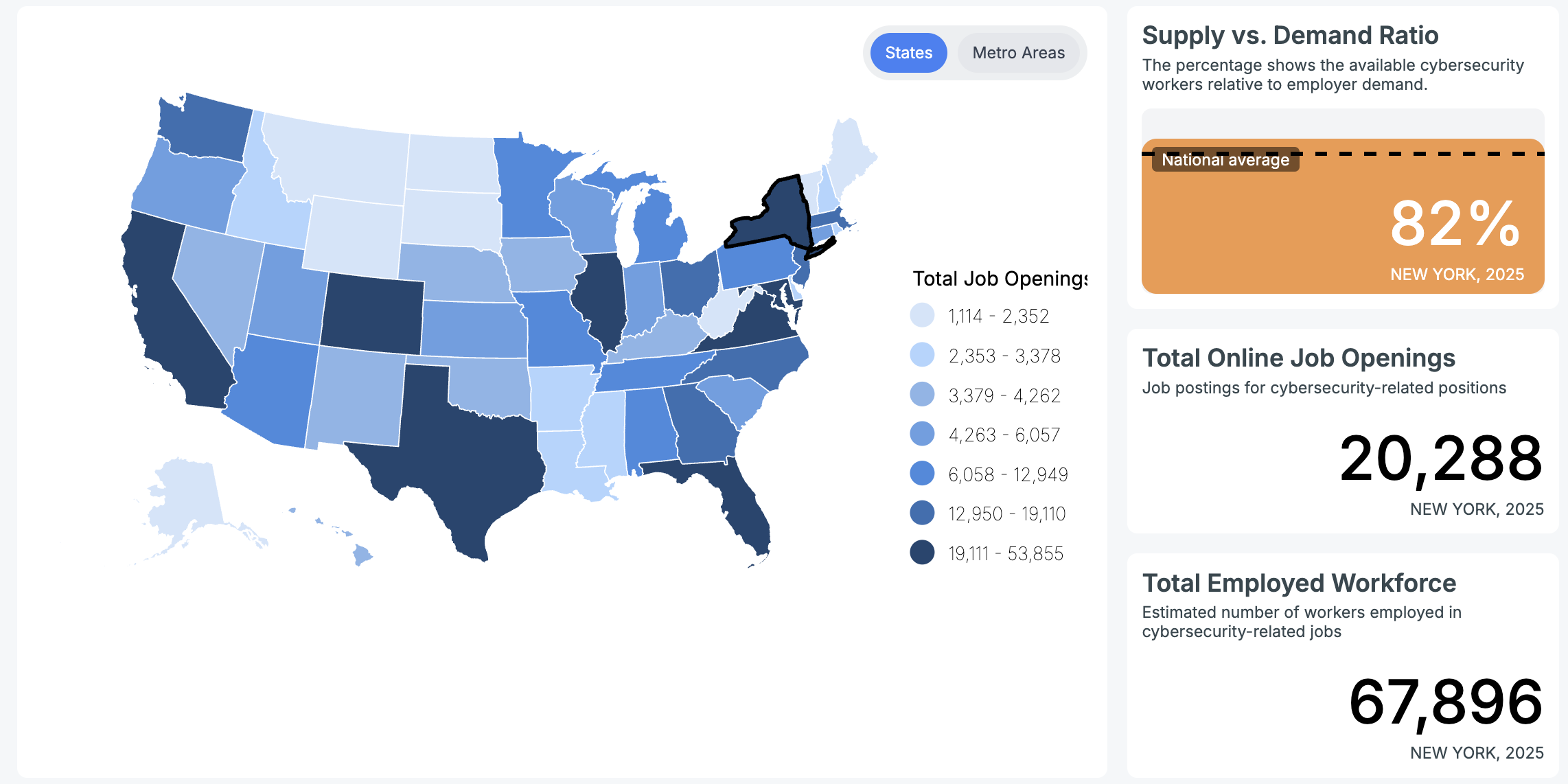
For information security analysts, the New York State Department of Labor projects employment to rise from 8,170 to 8,800 from 2022 to 2032, with about 663 annual openings statewide. That makes the occupation one of the clearer state-level indicators of sustained cybersecurity demand.
The wage picture is also strong. In the most recent readily accessible state occupational estimates from the BLS, New York had about 8,710 information security analysts with a mean annual wage of $140,770. In the same release, New York had about 20,020 network and computer systems administrators with a mean annual wage of $109,340.
CyberSeek reflects online job-posting demand, while BLS OEWS reflects estimated employment and wages, and New York DOL projections estimate expected long-term change and annual openings. For students comparing programs, the combination is useful: postings show hiring intensity, wage data show pay levels, and projections show whether the state expects the field to keep expanding.
Related resources
Cybersecurity degree pathways in New York
Associate degrees
Associate programs are usually the most direct entry point for students seeking hands-on technical training and a faster path into help desk, network support, or junior security roles.
We track 69 cybersecurity programs at 45 New York schools: 13 associate's degree programs, 20 bachelor's degree programs, 22 master's degree programs, 2 PhD programs, 9 certificate programs and 3 bootcamps. 41 of them can be completed fully or partly online, and 19 schools hold an NSA Center of Academic Excellence (CAE) designation. In-state students pay as little as $210 per credit, at CUNY Bronx Community College.
Prices are tuition only and don't include fees. Data last verified .
| School and program | Level and format | Per credit | Total | Credits | CAE | Compare |
|---|---|---|---|---|---|---|
| Bryant & Stratton College-AlbanyNetworking Technology, AAS · Albany, New York | Associate'sOnline + Campus | $682 | $40,920 est. | 60 | – | |
| CUNY Bronx Community CollegeComputer Information Systems AAS · Bronx, New York | Associate'sCampus | $210in-state | $12,600 est. | 60–61 | – | |
| Herkimer County Community CollegeCybersecurity & Digital Forensics A.S. · Herkimer, New York | Associate'sOnline + Campus | $225in-state | $13,950 est. | 62 | – | |
| Mohawk Valley Community CollegeComputer Science: Cybersecurity A.S. · Utica, New York | Associate'sHybrid + Campus | $228in-state | $14,364 est. | 63 | CD | |
| Onondaga Community CollegeCybersecurity A.S. · Syracuse, New York | Associate'sCampus | $232in-state | $14,152 est. | 61–63 | – | |
| Orange County Community CollegeCyber Security (A.A.S.) · Middletown, New York | Associate'sCampus | $257in-state | $16,705 est. | 65 | – | |
| Rockland Community CollegeCyber Security AAS · Suffern, New York | Associate'sCampus | $236in-state | $15,104 est. | 64 | CD | |
| St. John’s UniversityCyber Security Systems, Associate of Science · Queens, New York | Associate'sCampus | $1,871 | $112,260 est. | 60 | – | |
| Suffolk County Community CollegeCybersecurity and Information Assurance A.A.S. · Selden, New York | Associate'sCampus | $252in-state | $15,876 est. | 63 | CD | |
| SUNY Broome Community CollegeComputer Security and Forensics: A.A.S. · Binghamton, New York | Associate'sFully online | $249in-state | $15,936 est. | 64 | – | |
| SUNY Westchester Community CollegeCybersecurity A.A.S. · Valhalla, New York | Associate'sCampus | $238in-state | $14,994 est. | 63 | – | |
| Tompkins Cortland Community CollegeComputer Information Systems A.A.S. · Dryden, New York | Associate'sFully online | $236in-state | $14,632 est. | 62–64 | – | |
| Trocaire CollegeCybersecurity A.A.S. · Buffalo, New York | Associate'sOnline + Campus | $985 | $61,070 est. | 62 | – | |
| Excelsior UniversityBachelor of Science in Cybersecurity · Albany, New York | Bachelor'sOnline + Hybrid | $510 | $61,200 est. | 120 | CD | |
| Excelsior UniversityBachelor of Science in Information Technology · Albany, New York | Bachelor'sFully online | $510 | $61,200 est. | 120 | CD | |
| Hilbert CollegeCybersecurity, BS · Hamburg, New York | Bachelor'sOnline + Campus | $1,512 | $67,200 est. | 120 | – | |
| Hofstra UniversityCybersecurity, BS · Hempstead, New York | Bachelor'sCampus | $2,100 | $260,400 est. | 124 | – | |
| Iona UniversityBachelor of Science in Computer Science (Cyber Security concentration) · New Rochelle, New York | Bachelor'sCampus | $1,565 | – | – | – | |
| Mercy UniversityCybersecurity, Bachelor of Science · Dobbs Ferry, New York | Bachelor'sOnline + Campus | $990 | $118,800 est. | 120 | CD | |
| Monroe UniversityBachelor of Science in Computer Networks and Cybersecurity · Bronx, New York | Bachelor'sOnline + Hybrid + Campus | $725 | $84,000 est. | 120 | – | |
| Pace University#2 bachelor's programCybersecurity, BS · New York, New York | Bachelor'sCampus | $1,580 | $189,600 est. | 120 | CD | |
| Pace University-New YorkInformation Technology, BS (Cybersecurity concentration) · New York, New York | Bachelor'sCampus | $1,580 | $189,600 est. | 120 | – | |
| Rochester Institute of Technology#5 bachelor's programCybersecurity BS · Rochester, New York | Bachelor'sCampus | $2,352 | $296,352 est. | 126 | CD, R | |
| Rochester Institute of TechnologyCybersecurity BS · Rochester, New York | Bachelor'sCampus | $2,352 | – | – | CD, R | |
| St. Bonaventure University#4 bachelor's programBachelor of Science in Cybersecurity · St. Bonaventure, New York | Bachelor'sCampus | $1,275 | $153,000 est. | 120 | – | |
| St. John’s UniversityCyber Security Systems, Bachelor of Science · Queens, New York | Bachelor'sCampus | $1,871 | $224,520 est. | 120 | – | |
| State University of New York at AlbanyBachelor of Science in Informatics · Albany, New York | Bachelor'sOnline + Campus | Tuition not published separatelyUAlbany publishes 2026-2027 undergraduate tuition as $7,070 a year (NY resident) and $29,130 (out of state) for full-time study; its per-credit figures include fees (online: $366.46 resident, $424.46 out of state for one credit). | 120 | CD, R | ||
| SUNY CantonCybersecurity B.S. · Canton, New York | Bachelor'sOnline + Campus | $295in-state | $42,713 est. | 121–122 | CD | |
| SUNY PlattsburghCybersecurity Management, B.S. · Plattsburgh, New York | Bachelor'sOnline + Campus | $295in-state | $35,400 est. | 120 | – | |
| SUNY Polytechnic Institute#3 bachelor's programCybersecurity (B.S.) · Utica, New York | Bachelor'sOnline + Campus | $295in-state | $36,580 est. | 124 | – | |
| Touro UniversityCybersecurity and Network Administration · New York City, New York | Bachelor'sOnline + Campus | $725 | $87,000 est. | 120 | CD | |
| University at AlbanyBachelor of Science in Cybersecurity · Albany, New York | Bachelor'sOnline + Campus | Tuition not published separatelyUAlbany publishes only tuition-plus-fees per credit for Fall 2026 to Spring 2027: $397.41 for NY residents and $1,316.41 for out-of-state students on campus, and $366.46 / $424.46 for exclusively online programs. | – | – | ||
| Utica University#1 bachelor's programB.S. in Cybersecurity (Online) · Utica, New York | Bachelor'sFully online | $475 | $57,000 est. | 120 | CD | |
| Albany Law SchoolOnline M.S. in Cybersecurity and Data Privacy · Albany, New York | Master'sFully online | $1,738 | $52,140 | 30 | – | |
| City College of New YorkCybersecurity M.S. · New York, New York | Master'sCampus | $470in-state | – | – | CD | |
| Empire State UniversityM.S. in Cybersecurity · Saratoga Springs, New York | Master'sFully online | $471in-state | $14,130 est. | 30–33 | – | |
| Excelsior UniversityMaster of Science in Cybersecurity · Albany, New York | Master'sOnline + Hybrid | Tuition not published separatelyExcelsior publishes $715 per credit for graduate programs as an all-inclusive rate covering student services, technology and degree-conferral charges, with no separate tuition-only figure. | 30 | CD | ||
| Fordham UniversityMaster of Science in Cybersecurity · Bronx, New York | Master'sOnline + Hybrid + Campus | $1,789 | $53,670 est. | 30 | CD | |
| Hofstra UniversityMS in Cybersecurity · Hempstead, New York | Master'sOnline + Campus | $1,826 | $54,780 est. | 30 | – | |
| Mercy University#8 master's programCybersecurity M.S. · Dobbs Ferry, New York | Master'sOnline + Hybrid + Campus | $1,147 | $34,410 est. | 30 | CD | |
| New York Institute of Technology#3 master's programCybersecurity, M.S. · New York, New York | Master'sCampus | $1,800 | $54,000 est. | 30 | CD | |
| New York University#9 master's programCybersecurity, M.S. · Brooklyn, New York | Master'sOnline + Campus | $2,626 | $78,780 est. | 30 | CD, CO | |
| Pace UniversityCybersecurity, MS · New York City & Westchester, New York | Master'sOnline + Campus | $1,730 | $39,450 est. | 30 | CD | |
| Rochester Institute of Technology#10 master's programCybersecurity MS · Rochester, New York | Master'sOnline + Campus | $2,690 | $80,700 est. | 30 | CD, R | |
| St. Bonaventure University#1 master's programMaster of Science in Cybersecurity · St. Bonaventure, New York | Master'sFully online | $805 | $24,150 est. | 30 | – | |
| St. John's UniversityCyber and Information Security, Master of Science · Queens, New York | Master'sOnline + Campus | $1,705 | $30,000 est. | 30 | CD | |
| SUNY Polytechnic Institute#7 master's programCybersecurity (MS) · Utica, New York | Master'sOnline + Campus | $471in-state | $15,543 est. | 33 | – | |
| Syracuse UniversityMaster of Science in Cybersecurity · Syracuse, New York | Master'sOnline + Campus | $2,086 | $62,580 est. | 30 | CD, R | |
| Touro University#2 master's programMaster of Science in Cybersecurity and Network Administration · New York, New York | Master'sOnline + Hybrid | $910 | $30,030 est. | 33 | CD | |
| University at AlbanyMaster of Science in Digital Forensics and Cybersecurity · Albany, New York | Master'sOnline + Campus | Tuition not published separatelyUAlbany publishes only tuition-plus-fees per credit for Fall 2026 to Spring 2027: $616.33 for NY residents and $1,249.33 for out-of-state students in non-MBA master's programs. | 33–39 | – | ||
| University at Buffalo#6 master's programEngineering Science (Cybersecurity) MS · Buffalo, New York | Master'sCampus | $471in-state | $14,130 est. | 30 | – | |
| University of AlbanyOnline MBA (Cybersecurity elective track) · Albany, New York | Master'sOnline + Campus | Tuition not published separatelyUAlbany publishes online MBA per-credit rates only as tuition plus fees ($704.38 NY resident, $827.38 out of state for one credit, Fall 2026/Spring 2027). | 48 | – | ||
| Utica University#5 master's programCybersecurity (M.S.) · Utica, New York | Master'sOnline + Campus | $895 | $26,850 est. | 30 | CD | |
| Utica UniversityManagement M.B.A. (Online), Cybersecurity Leadership specialization · Utica, New York | Master'sFully online | $700 | $21,000 est. | 30 | CD | |
| Yeshiva University#4 master's programM.S. in Cybersecurity · New York, New York | Master'sOnline + Campus | $1,445 | $43,350 est. | 30 | – | |
| New York Institute of TechnologyComputer Science, Ph.D. · New York | DoctorateCampus | $1,800 | $118,800 est. | 66 | CD | |
| Rochester Institute of TechnologyComputing and Information Sciences Ph.D. · Rochester, New York | DoctorateCampus | $2,690 | $161,400 est. | 60 | CD, R | |
| CUNY Bronx Community CollegeCybersecurity and Networking Certificate · Bronx, New York | CertificateCampus | $210in-state | $6,300 est. | 30 | – | |
| Excelsior UniversityGraduate Certificate in Cybersecurity Operations · Albany, New York | CertificateFully online | Tuition not published separatelyExcelsior publishes $716 per credit ($6,444 for 9 credits) as an all-inclusive price, with no separate tuition-only figure. | 9 | CD | ||
| Pace University-New YorkAdvanced Certificate in Secure Software and Information Engineering · NYC and Westchester, New York | CertificateOnline + Campus | $1,315 | $23,670 | 18 | – | |
| Rochester Institute of TechnologyCybersecurity Advanced Certificate · Rochester, New York | CertificateCampus | $2,690 | $32,280 est. | 12 | CD, R | |
| SUNY at AlbanyEmergency Preparedness, Homeland Security and Cybersecurity Certificate Program · Albany, New York | CertificateCampus | Tuition not published separatelyUAlbany publishes per-credit graduate rates only as tuition plus fees (one credit: $616.33 NY resident, $1,249.33 out of state, Fall 2026/Spring 2027); full-time tuition alone is published per semester. | 15 | CD, R | ||
| SUNY Erie Community CollegeNetwork Support Technology Certificate · Buffalo, New York | CertificateCampus | $217in-state | – | – | – | |
| SUNY Westchester Community CollegeCybersecurity Certificate · Valhalla, New York | CertificateCampus | $238in-state | $6,426 est. | 27 | – | |
| University at Albany-State University of New YorkCertificate of Graduate Study in Information Security · Albany, New York | CertificateCampus | Tuition not published separatelyUAlbany publishes per-credit graduate rates only as tuition plus fees (one credit: $616.33 NY resident, $1,249.33 out of state, Fall 2026/Spring 2027); full-time tuition alone is published per semester. | 15 | CD, R | ||
| University at BuffaloAdvanced Certificate in Cybersecurity · Buffalo, New York | CertificateCampus | – | – | 14–15 | – | |
| Borough of Manhattan Community CollegeCybersecurity Boot Camp · New York, New York | BootcampFully online | – | $4,634 | 6 months | – | |
| Flatiron SchoolCybersecurity Certificate (part-time) · New York, New York | BootcampFully online | – | $14,900 | 15 months | – | |
| Fullstack AcademyCybersecurity Bootcamp · Brooklyn, New York | BootcampFully online | – | – | 13-18 weeks | – | |
In New York, the best fit is typically a program that combines networking, systems administration, scripting, and security fundamentals with transfer options into a bachelor’s pathway. Students should look for labs, employer-facing coursework, and clear transfer articulation rather than just course titles.
Bachelor’s degrees
A bachelor’s degree remains the most common long-term pathway for security analyst, engineering, and architecture roles. In New York, students should prioritize programs that include applied research, industry collaboration, or innovation infrastructure rather than those that list only standard security courses.
One distinctive example is Stony Brook University’s CEWIT, the New York State Center of Excellence in Wireless and Information Technology.
CEWIT states that its mission includes conducting interdisciplinary research, fostering new enterprise development, and addressing the skilled technology worker shortage; its research areas also explicitly include cybersecurity. That kind of research-and-commercialization environment can matter for students who want internships, startup exposure, or applied projects alongside a degree.
Master’s degrees
Master’s programs in cybersecurity are usually best for students who already have a computing background or who want to move into security engineering, cyber operations, architecture, policy, or leadership roles.
In New York, the differentiator is often whether a graduate program connects students to real research, government, critical-infrastructure work, or employer partnerships rather than simply offering advanced coursework.
Certifications and workforce programs
Shorter workforce pathways can make sense for career changers or students who want to stack credentials while enrolled in a degree.
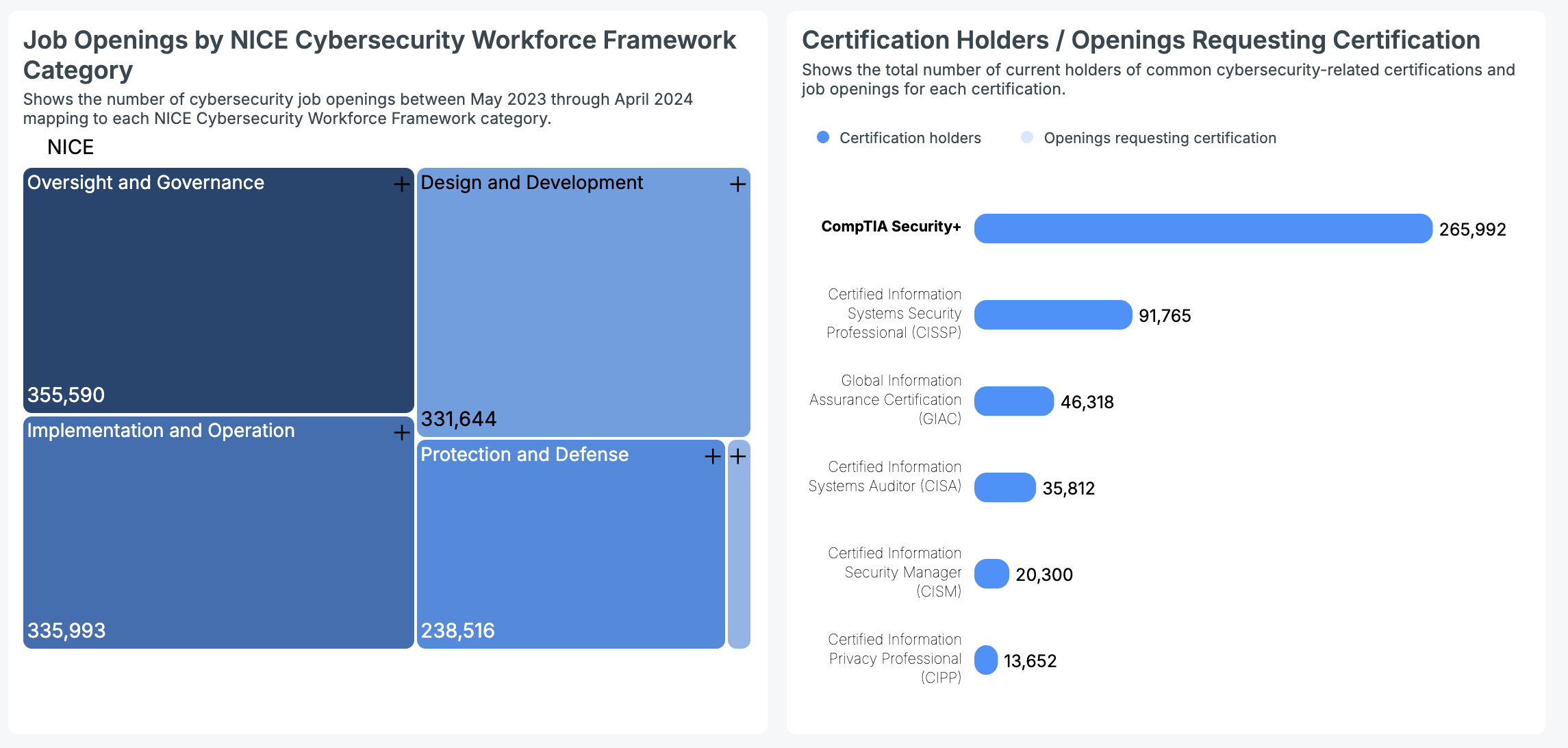
New York’s labor market and OEWS resources are useful for checking whether a shorter credential aligns with occupations that still show strong projected openings and strong wages.
Students should favor programs that include labs, incident-response practice, networking fundamentals, and an obvious path into either employment or a later bachelor’s degree.
Scholarship for Service
New York does participate in the federal CyberCorps Scholarship for Service pipeline. At the University at Buffalo, the official SFS page says the scholarship can cover tuition and fees, professional development, and an annual stipend of $27,000 for undergraduates and $37,000 for graduate students for eligible cybersecurity studies tied to government service commitments.
For students interested in public-sector cyber careers, that is one of the clearest state-based options to look at first.
Unique New York cybersecurity initiatives
New York’s statewide cybersecurity coordination runs through the Chief Information Security Office inside the Office of Information Technology Services.
The state says this office is responsible for protecting the state government’s cybersecurity infrastructure and for statewide coordination of cybersecurity policies, standards, and programs.
That matters for students because it signals a visible state-level cybersecurity governance structure and a public-sector ecosystem where internships, government service, and policy-adjacent careers can matter.
At the university level, Stony Brook’s CEWIT stands out because it combines research, commercialization, industry relationships, and workforce language in one initiative.
CEWIT says it was created to conduct research and commercialization, facilitate interaction between companies and university faculty and students, and address the skilled technology worker shortage; it also highlights cybersecurity among its research areas and conference themes.
Frequently asked questions about cybersecurity degrees in New York
CyberSeek’s New York state heat map tracks statewide cybersecurity job openings, employed workforce, and supply-demand conditions, and New York remains one of the larger cybersecurity labor markets in the country by volume. For a state-specific occupation benchmark, New York also projects about 663 annual openings for information security analysts from 2022 to 2032.
Using BLS state wage estimates, information security analysts in New York had a mean annual wage of $140,770 in the latest easily verifiable state occupation page, while network and computer systems administrators averaged $109,340. Those figures make New York one of the higher-paying states for cyber-related work.
There is no single best degree for every student. For most learners, the strongest option is the program that combines core security coursework with hands-on labs, employer exposure, and a distinctive research or workforce initiative such as a university center, state partnership, or federally funded scholarship path.
Yes. New York institutions include online and hybrid cybersecurity options, especially at the graduate and professional level. When comparing them, students should look past delivery format and focus on whether the program still offers labs, technical depth, and a clear connection to employment or government-service pathways.
Yes, but quality varies. The better short-term options are the ones that complement, rather than replace, core computing foundations and that align with occupations the state still projects to grow. New York’s own labor-market tools are useful for checking that alignment before enrolling.
CyberSeek includes a certifications section in its heat map so users can compare certification holders with openings requesting certifications in a given market. Because those rankings are dynamic, the safest way to check New York-specific certification demand is to use the live state filter rather than rely on a static list.
Yes. The combination of CyberSeek statewide demand tracking, New York’s projected growth from 8,170 to 8,800 information security analyst jobs, and strong BLS wages all point to continuing demand.
Yes. An associate degree can be a practical starting point, especially if it includes networking, systems, and security fundamentals plus a transfer pathway into a bachelor’s program. For many students, that is a lower-risk way to enter the field and build toward roles that later require more depth.
A typical associate degree takes about 2 years, a bachelor’s degree about 4 years, and a master’s degree about 1 to 2 years, depending on credits, pace, and whether the student studies full-time. Scholarship and workforce pathways can shorten or reshape that timeline, especially for students already in computing-related programs.
Yes. New York has official SFS participation, including the University at Buffalo program, which states that it supports eligible cybersecurity studies in exchange for later government service.
New York’s market supports cybersecurity hiring across finance, healthcare, government, technology, consulting, and research-heavy organizations. The state’s wage levels and employer base make it relevant for both technical and policy-adjacent cybersecurity careers.
Yes, but many “entry-level” cyber jobs still expect some prior IT grounding. Associate pathways, internships, research centers, and stacked credentials can help students move into junior analyst, SOC support, network support, or systems roles that feed into higher-level security work later.
Sources
- CyberSeek | Cybersecurity Supply/Demand Heat Map | Accessed March 11, 2026
- New York State Department of Labor | Employment Projections | Accessed March 11, 2026
- New York State Department of Labor | Statistics: Statewide Long-Term Occupational Projections | Accessed March 11, 2026
- U.S. Bureau of Labor Statistics | OEWS State Occupational Employment and Wage Estimates | Accessed March 11, 2026
- New York State Office of Information Technology Services | Cybersecurity | Accessed March 11, 2026
- Stony Brook University CEWIT | About / Mission and Overview | Accessed March 11, 2026
- Stony Brook University CEWIT | Home | Accessed March 11, 2026
- University at Buffalo | CyberCorps®: Scholarship for Service (SFS) Program at NSF | Accessed March 11, 2026
- U.S. Office of Personnel Management | CyberCorps®: Scholarship for Service | Accessed March 11, 2026
- New York State Department of Labor | January 2026 Issue of the Employment in New York State Newsletter | Accessed March 11, 2026