- Associate degree
- Bachelor’s degree
- Master’s degree
- Cybersecurity certifications
- Cybersecurity initiatives in NM
- FAQs
Students pursuing a cybersecurity degree in New Mexico can choose from associate, bachelor’s, and graduate programs designed to prepare graduates for careers in information security and cyber defense. Several cybersecurity schools in New Mexico offer academic and applied training aligned with workforce needs in government, research laboratories, and private industry.
This guide focuses specifically on cybersecurity programs in New Mexico, emphasizing degree pathways and distinctive education or workforce initiatives rather than general school listings.
This page focuses on degree and school pathways and references institutions only when there is a distinctive workforce partnership, research initiative, or specialized training environment.
How we keep this page current
This page is updated using authoritative sources including CyberSeek, the Bureau of Labor Statistics, the New Mexico Department of Workforce Solutions, the New Mexico Department of Information Technology, and the NSF Scholarship for Service program. Institutional initiatives are verified against official university and state program pages.
The page is reviewed periodically to ensure labor market data and program information remain current, and outdated or unsupported claims are removed or updated.
Ad
cybersecurityguide.org is an advertising-supported site. Clicking in this box will show you programs related to your search from schools that compensate us. This compensation does not influence our school rankings, resource guides, or other information published on this site.
Featured Cybersecurity Degree Programs
| School Name | Program | More Info |
|---|---|---|
| Grand Canyon University | Online BS in Cybersecurity or Online MS in Cybersecurity | website |
| Arizona State University | Online MA in Global Security - Cybersecurity | website |
| Southern New Hampshire University | Online BS in Cybersecurity or Online MS in Cybersecurity | website |
| Syracuse University | Online MS in Cybersecurity | Complete in 15 Months | website |
| Purdue Global | Online BS in Cybersecurity | website |
Cybersecurity workforce demand in New Mexico
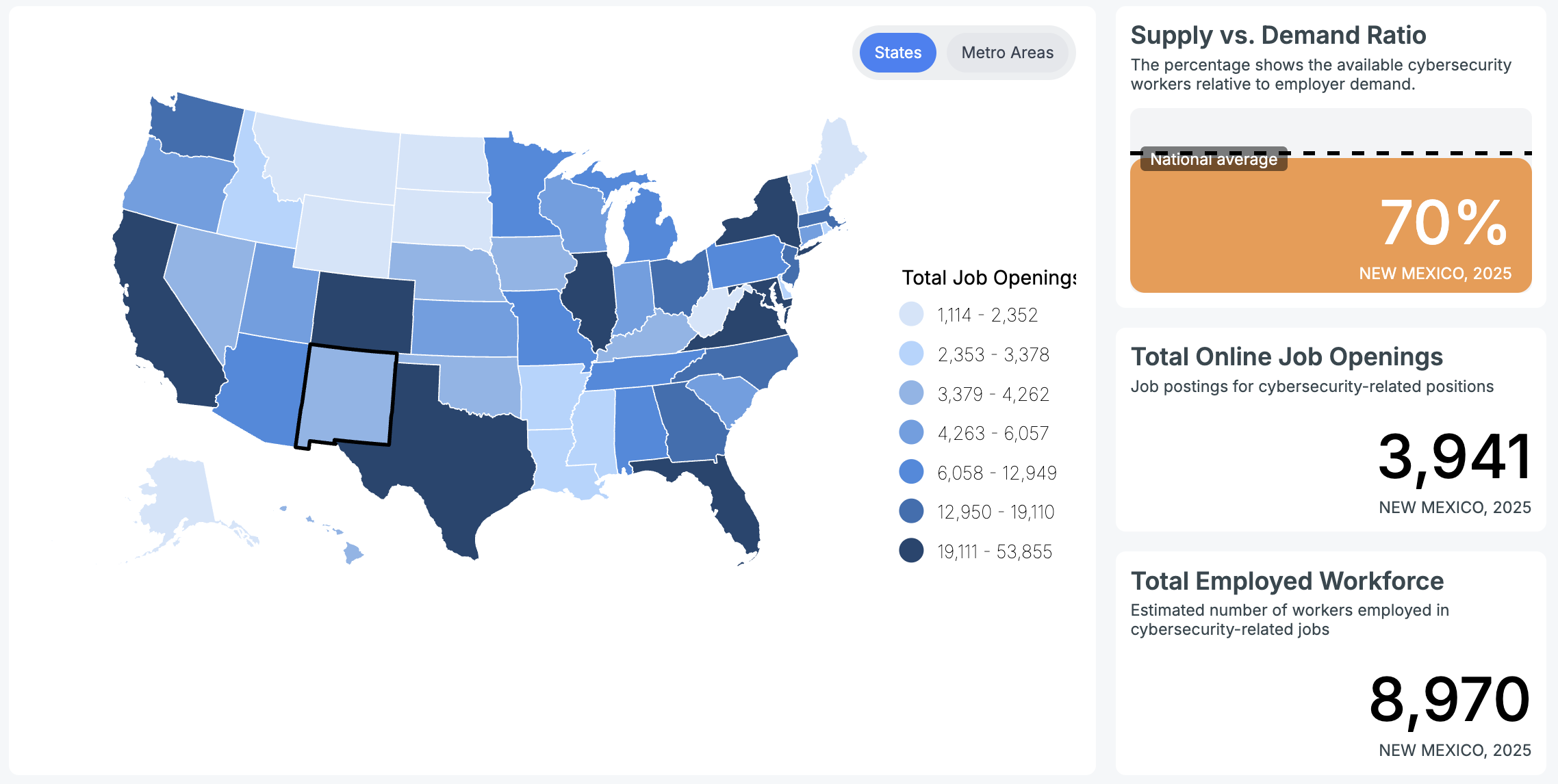
Employer demand for cybersecurity professionals in New Mexico is driven largely by federal agencies, national laboratories, healthcare organizations, and defense contractors.
According to CyberSeek, New Mexico typically reports hundreds to over one thousand cybersecurity-related job postings annually, reflecting steady employer demand. CyberSeek data represents employer job postings and certification requests rather than total employment.
State projections indicate a continued need for cybersecurity professionals. The New Mexico Department of Workforce Solutions identifies information security analysts as a growing occupation within the state workforce.
According to the Bureau of Labor Statistics, Information Security Analysts in New Mexico earn a mean annual wage of approximately $116,000, reflecting strong salaries relative to many other occupations in the state. BLS employment estimates measure the number of workers employed in an occupation rather than hiring demand.
BLS data also shows employment of Network and Computer Systems Administrators in New Mexico with mean wages around $95,000, representing a common pathway into cybersecurity careers (BLS Occupational Employment Statistics).
Together, CyberSeek demand signals, state projections, and BLS wage data indicate consistent demand for cybersecurity professionals in New Mexico, particularly in government and research sectors.
Related resources
Cybersecurity degree pathways in New Mexico
Students in New Mexico can pursue cybersecurity education through multiple academic and workforce-oriented pathways.
Associate degrees
Associate degrees provide a starting point for students entering cybersecurity or IT support roles. Typical coursework includes:
- Network security fundamentals
- Operating systems
- Security administration
- Cyber defense basics
- Ethical hacking concepts
Students evaluating associate programs should look for:
- Certification-aligned coursework
- Hands-on lab environments
- Transfer pathways to bachelor’s programs
Associate degrees can provide a lower-cost entry into cybersecurity education and often transfer into four-year degree programs.
Central New Mexico Community College
Albuquerque, New Mexico Program: AAS Cyber Security
Credits: 62
Cost per credits: $179
Delivery method: Online
Learn more: Program detailsEastern New Mexico University-Ruidoso Campus
Ruidoso, New MexicoProgram: Associate of Applied Science in Information Systems Cybersecurity
CAE designation: CAE-CD
Credits: 63
Cost per credit: $53 in state | $106 out of state
Delivery Method: Campus
Learn more: Program detailsNational American University-Albuquerque West
Albuquerque, New MexicoProgram: Online Information Technology Associate Program - Computer Security
Credits: 93
Cost per credits: $380
Delivery method: Online
Learn more: Program detailsUniversity of New Mexico-Los Alamos Campus
Los Alamos, New MexicoProgram: Associate of Applied Science in Information Technology – Cybersecurity Emphasis
Credits: 60-62
Cost per credit: $140 in-state | $371 out of state
Delivery method: Campus
Learn more: Program details
Bachelor’s degrees
Bachelor’s degrees are the most common educational requirement for cybersecurity professionals. Programs typically include coursework in:
- Network security
- Digital forensics
- Secure system design
- Risk management
- Incident response
- Cloud security
Students evaluating bachelor’s programs should consider:
- Hands-on lab environments
- Internship opportunities
- Industry partnerships
- National Center of Academic Excellence designation
The University of New Mexico Center for Information Assurance supports cybersecurity education and research and provides students with applied training opportunities through partnerships with government and industry.
The New Mexico Institute of Mining and Technology Information Security Center conducts applied cybersecurity research and supports student involvement in security-focused research projects.
Programs with applied training components provide opportunities for students to gain practical cybersecurity experience alongside academic coursework.
New Mexico Institute of Mining and Technology
Socorro, New MexicoProgram: Bachelor of Science Degree in Information Technology – Security and Assurance Track
Credits: 120
Cost per credit: $308 in-state | $883 out-of-state
Delivery method: Campus
Learn more: Program detailsNew Mexico State University
Las Cruces, New MexicoProgram: Bachelor of Information and Communication Technology (ICT) - Cybersecurity concentration
Credits: 120
Cost per credit: $395
Delivery method: Online
Learn more: Program detailsEC-Council University
Albuquerque, New MexicoProgram: Bachelor’s Degree in Cyber Security (BSCS)
Credits: 60
Cost per credit: $465.00
Delivery method: Online
Learn more: Program details
Master’s degrees
Master’s-level cybersecurity programs support advancement into specialized or leadership roles including:
- Security engineering
- Cybersecurity architecture
- Incident response leadership
- Security analytics
- Cyber risk management
Graduate programs often include:
- Advanced cryptography
- Secure systems design
- Malware analysis
- Threat intelligence
- Security analytics
Students considering graduate degrees should evaluate:
- Research opportunities
- Industry partnerships
- Flexible learning options
- Capstone or thesis requirements
Graduate programs are often pursued by IT professionals transitioning into cybersecurity roles.
EC-Council University
Albuquerque, New MexicoProgram: Master’s in Cyber Security (MSCS)
Credits: 36
Cost per credit: $540
Delivery method: Online
GRE Requirement: Not required
Learn more: Program detailsUniversity of New Mexico
Albuquerque, New MexicoProgram: Cybersecurity and Business Analytics (MS-CBA)
CAE designation: CAE-R
Credits: 33
Cost per credit: $805
Delivery method: Online
GRE Requirement: Not required
Learn more: Program details
Certifications and workforce programs
Short-term training programs provide alternative entry points into cybersecurity careers or opportunities for career advancement.
These programs often include:
- Certification-focused coursework
- Hands-on labs
- Employer-aligned training
- Flexible scheduling
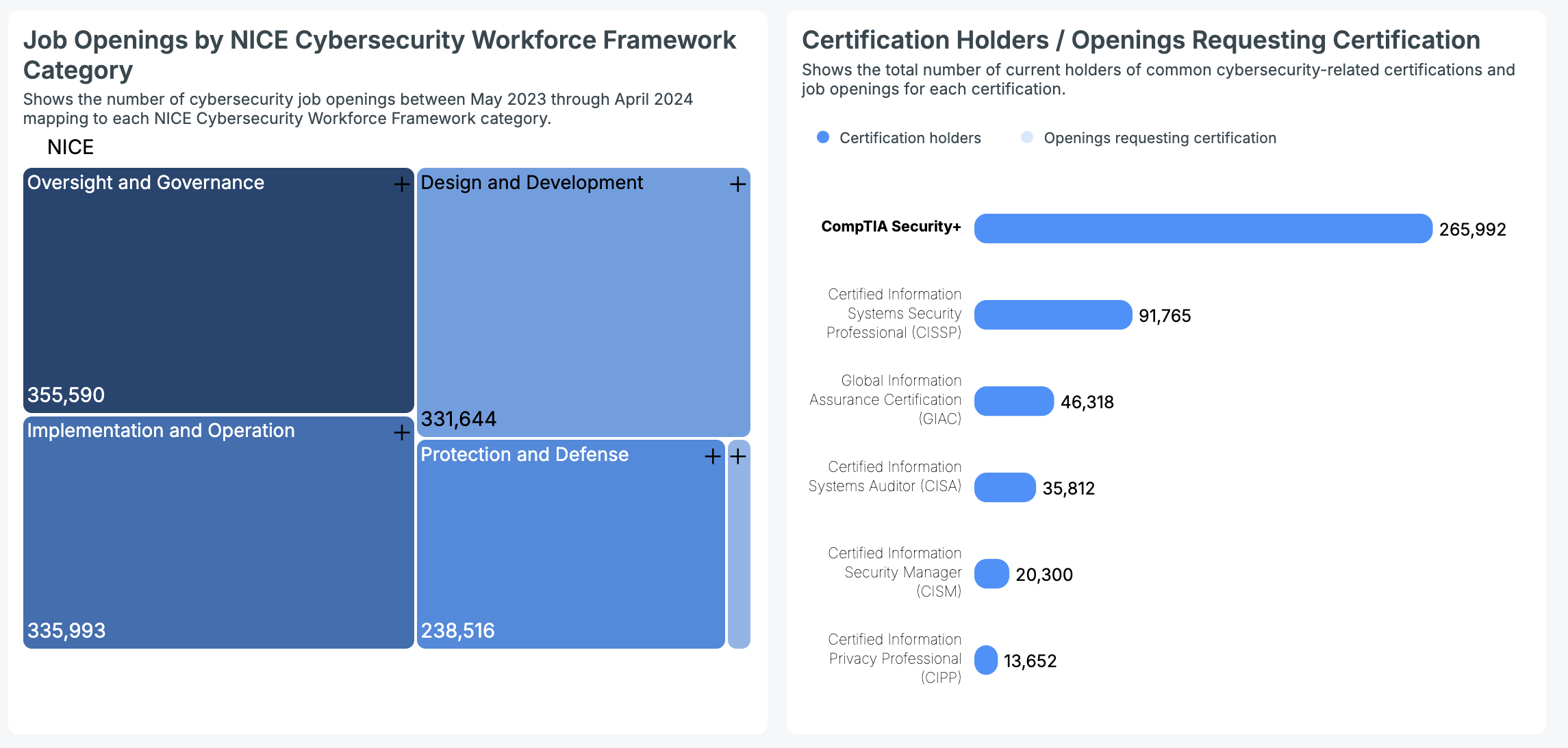
Common certifications requested by employers include:
- CompTIA Security+
- CISSP
- Certified Ethical Hacker (CEH)
Certification demand data from CyberSeek shows Security+ and CISSP among the most commonly requested cybersecurity credentials.
Eastern New Mexico University-Ruidoso Campus
Ruidoso, New MexicoProgram: Certificate in Computer & Network Security
CAE designation: CAE-CD
Credits: 21
Cost per credit: $53 in state | $106 out of state
Delivery method: Campus
Learn more: Program detailsSanta Fe Community College
Santa Fe, New MexicoProgram: Computer and Network Security Certificate
Credits: 22
Cost per credit: $49 in state | $144 out of state
Delivery method: Campus
Learn more: Program details
Scholarship for Service
New Mexico institutions have participated in the federal Scholarship for Service program, which provides cybersecurity scholarships in exchange for government service after graduation.
Scholarship for Service programs typically include:
- Full tuition support
- Living stipends
- Internship placements
- Government career pathways
Students should verify current participation through the Scholarship for Service program directory.
Unique New Mexico cybersecurity initiatives
The New Mexico Department of Information Technology coordinates statewide cybersecurity initiatives and supports workforce development across public-sector organizations.
The state’s national laboratories and federal agencies play an important role in cybersecurity workforce development through partnerships with higher education institutions.
The University of New Mexico Center for Information Assurance provides applied cybersecurity training and research partnerships involving government agencies and private-sector organizations.
The New Mexico Tech Information Security Center supports applied research and workforce development activities tied to cybersecurity education.
These initiatives support practical training opportunities aligned with New Mexico’s cybersecurity workforce needs.
Frequently asked questions about cybersecurity degrees in New Mexico
CyberSeek reports hundreds to over one thousand cybersecurity job postings annually in New Mexico, indicating steady employer demand (CyberSeek). Job posting data reflects hiring demand rather than total employment.
Information Security Analysts in New Mexico earn a mean annual wage of about $116,000, according to the Bureau of Labor Statistics.
Most cybersecurity professionals begin with a bachelor’s degree that includes coursework in network security, digital forensics, and risk management. Programs with hands-on labs and employer partnerships typically provide strong preparation.
Yes. Some New Mexico institutions offer online or hybrid cybersecurity programs. Students should confirm delivery formats directly with institutions.
Yes. Workforce training programs in New Mexico often focus on certification preparation and hands-on cybersecurity skills.
CyberSeek data shows frequently requested certifications include:
– CompTIA Security+
– CISSP
– Certified Ethical Hacker (CEH)
Yes. CyberSeek job-posting data and state workforce projections both indicate steady demand for cybersecurity professionals.
Yes. Associate degrees can lead to entry-level roles such as:
– IT support specialist
– Network technician
– Security technician
Many associate degree programs transfer into bachelor’s programs.
– Associate degree: about 2 years
– Bachelor’s degree: about 4 years
– Master’s degree: about 1–2 years
Yes. New Mexico institutions have participated in the federal Scholarship for Service program, which supports cybersecurity education in exchange for government service.
Cybersecurity graduates in New Mexico commonly work in: Federal government agencies, National laboratories, Healthcare organizations, Technology contractors, State and local government. These sectors rely heavily on cybersecurity professionals to protect sensitive information and infrastructure.
Yes. Entry-level roles include:
– Security analyst
– SOC analyst
– IT security specialist
– Network security technician
Many entry-level positions require both a degree and foundational certifications.
Sources
- CyberSeek | Cybersecurity Supply/Demand Heat Map | Accessed February 26, 2026
- Bureau of Labor Statistics | Occupational Employment and Wage Statistics | Accessed February 26, 2026
- Bureau of Labor Statistics | Network and Computer Systems Administrators | Accessed February 26, 2026
- New Mexico Department of Workforce Solutions | Labor Market Information Portal | Accessed February 26, 2026
- New Mexico Department of Information Technology | State Cybersecurity Programs | Accessed February 26, 2026
- University of New Mexico | Center for Information Assurance | Accessed February 26, 2026
- New Mexico Institute of Mining and Technology | Information Security Center | Accessed February 26, 2026
- NSF / OPM | CyberCorps Scholarship for Service | Accessed February 26, 2026