- Associate degrees
- Bachelor’s degrees
- Master’s degrees
- Cybersecurity certifications
- Cybersecurity Kansas initiatives
- FAQs
For students comparing cybersecurity education options, Kansas includes several college pathways linked to workforce demand in major industries such as finance, defense contracting, insurance, and healthcare.
This page is focused specifically on degree and school pathways, and institutions are referenced only when they offer distinctive research, workforce, or training initiatives.
How we keep this page current
This page is reviewed using Kansas-focused demand signals from CyberSeek, state projections from the Kansas Department of Labor, wage and employment estimates from the Bureau of Labor Statistics, Kansas state cybersecurity governance sources, and the federal CyberCorps® Scholarship for Service directory.
Any program or initiative claims about institutions are verified against official university or state pages. We periodically review this page and remove or revise time-sensitive claims that can’t be re-verified.
Ad
cybersecurityguide.org is an advertising-supported site. Clicking in this box will show you programs related to your search from schools that compensate us. This compensation does not influence our school rankings, resource guides, or other information published on this site.
Featured Cybersecurity Degree Programs
| School Name | Program | More Info |
|---|---|---|
| Purdue Global | Online BS in Cybersecurity | website |
| UC Berkeley School of Information | Master’s in Cybersecurity | No GRE/GMAT Required | website |
| Arizona State University | Online MA in Global Security - Cybersecurity | website |
| Southern New Hampshire University | Online BS in Cybersecurity or Online MS in Cybersecurity | website |
Cybersecurity workforce demand in Kansas
Cybersecurity demand is best understood by comparing online job postings (short-term employer demand) with employment estimates (how many people are working in relevant occupations) and projections (expected longer-term growth/openings).
- CyberSeek demand context: CyberSeek’s heat map provides Kansas-level indicators for cybersecurity job openings and workforce supply/demand over the recent 12-month periods.
- State projections/openings: Kansas Department of Labor projections materials include Information Security Analysts among faster-growing occupations statewide and report 15 average annual openings with an annual growth rate of 2.1% via the KDOL LMI “Projections Data Report”.
- BLS employment and wages: The BLS Occupational Employment and Wage Statistics (OEWS) estimates 1,850 Information Security Analysts employed in Kansas with an annual mean wage of $101,440.
- Another cyber-adjacent role: BLS OEWS reports 1,890 Computer Network Architects employed in Kansas with an annual mean wage of $103,610.
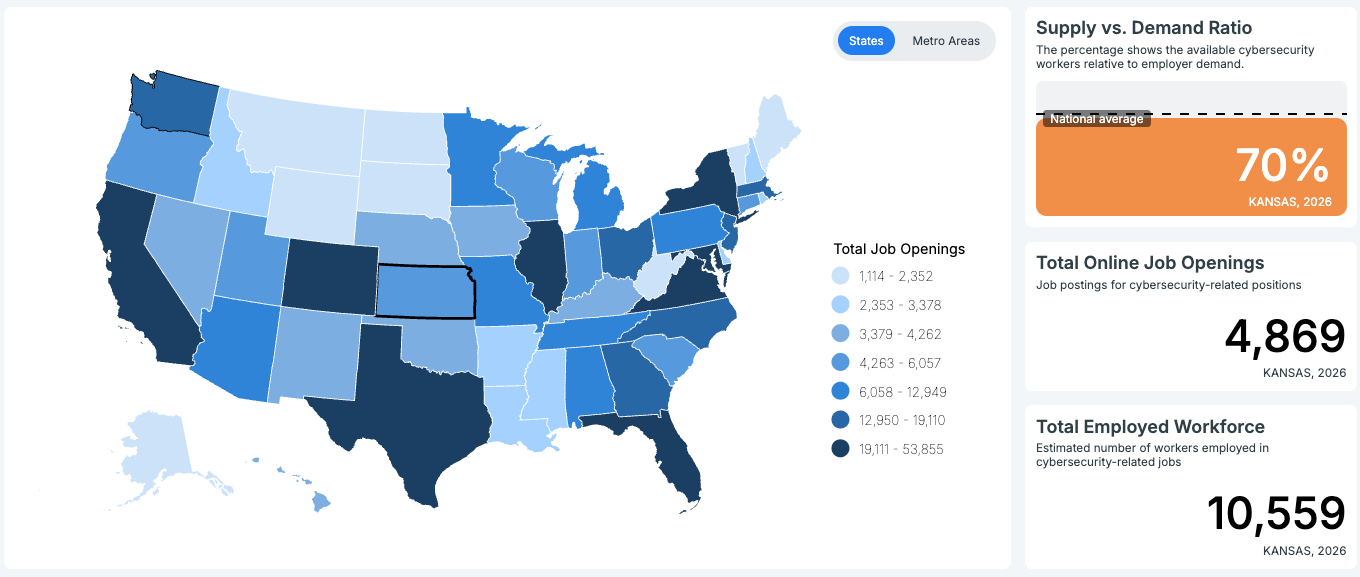
What these metrics do (and do not) mean: Job postings reflect recruiting activity, which can rise/fall faster than employment. Employment/wage estimates reflect current workforce levels, not vacancies. Projections estimate expected change and openings over time, not guaranteed jobs. For education planning, the most useful approach is to look for programs that build practical skills aligned to employer demand while still providing durable foundations.
Related resources
Cybersecurity degree pathways in Kansas
Associate degrees
Associate programs are commonly used to start in IT/security support and then transfer into a bachelor’s pathway. When evaluating options, prioritize:
- clear transfer pathways into a four-year cybersecurity or computing program
- coursework that maps to common security roles (networking, systems, incident response basics)
- lab-based learning (hands-on configuration, logging/monitoring, basic forensics)
Butler Community College
El Dorado, Kansas Program: Associate in Applied Science in Cyber Security
CAE designation: CAE-CD
Credits: 60
Cost per credit: $73 in state | $163 out of state
Delivery method: Campus
Learn more: Program detailsGarden City Community College
Garden City, KansasProgram: AS Degree in Cybersecurity
Credits: 60
Cost per credit: $63 in state | $82 out of state
Delivery method: Campus
Learn more: Program detailsJohnson County Community College
Overland Park, KansasProgram: Associate of Applied Science in Information Technology - Networking
Credits: 60
Cost per credit: $97 in state | $228 out of state
Delivery method: Campus
Learn more: Program details
Bachelor’s degrees
Bachelor’s programs are the most common route into analyst, engineering, and security operations roles. In Kansas, prioritize programs that show evidence of hands-on training environments and external validation (federal designation, formal centers, outreach/training pipelines).
Distinctive initiatives worth noting:
- University of Kansas (KU) – ITTC CAE program: KU’s Information and Telecommunication Technology Center is designated as a National Center of Academic Excellence in Cyber Defense (CAE-CD) and CAE-Research and supports cybersecurity education and outreach.
- Emporia State University – Cybersecurity Research and Outreach Center: ESU describes a dedicated center supporting seminars, camps, competitions, partnerships with businesses, and training/certifications.
What to look for (regardless of program name): security labs/cyber range access, internship pipelines, applied projects, and curriculum aligned to recognized frameworks (e.g., NICE/NIST).
Fort Hays State University
Hays, KansasProgram: BA or BS in Information Networking and Telecommunications, Concentration: Computer Networking and Telecommunications with Information Assurance Emphasis
CAE designation: CAE-CD
Credits: 120
Cost per credit: $181 in-state | $529.68 out-of-state
Delivery method: Campus & online
Learn more: Program detailsFriends University
Wichita, KansasProgram: Bachelor of Science in Cyber Security
Credits: 124
Cost per credit: $1,070
Delivery method: Campus
Learn more: Program detailsKansas State University
Manhattan, KansasProgram: BS in Computer Science – Cyber Security Track
Credits: 120
Cost per credit: $321 in-state | $865 out-of-state
Delivery method: Campus
Learn more: Program detailsWichita State University
Wichita, KansasProgram: Bachelor of Science in Engineering Technology – Cybersecurity
CAE designation: CAE-CD
Credits: 120
Cost per credit: $308 in-state | $462 out-of-state
Delivery method: Campus
Learn more: Program details
Master’s degrees
Master’s pathways are typically best for students aiming at security architecture, leadership, or specialized research. Kansas programs that connect graduate students to active research communities and cross-disciplinary security work are generally stronger than lecture-only degrees.
Distinctive initiative worth noting: Kansas State University – Center for Cybersecurity and Trustworthy Systems: K-State describes a center designed to facilitate interdisciplinary research and educational collaboration in cybersecurity and cyber-physical system security.
Friends University
Wichita, KansasProgram: Master of Science in Cyber Security
Credits: 33
Cost per credit: $636
Delivery method: Campus & online
GRE requirement: Not required
Learn more: Program detailsUniversity of Kansas
Lawrence, KansasProgram: Master of Science in Information Technology – Cyber Security Focus
CAE designation: CAE-CD, CAE-R
Credits: 30
Cost per credit: $437 in-state | $1,048 out of state
Delivery method: Campus
GRE requirement: Not required
Learn more: Program details
Certifications and workforce programs
Many degree programs incorporate certification preparation (or align content to it) rather than offering standalone “cert programs.” For short-term workforce training, prioritize:
- hands-on labs and measurable skill outcomes
- alignment to NICE/NIST role categories
- employer partnerships (internships, apprenticeships, practicum-style projects)
Butler Community College
El Dorado, KansasProgram: Cyber Security Certificate
CAE designation: CAE-CD
Credits: 30
Cost per credit: $73 in state | $163 out of state
Delivery method: Online
Learn more: Program detailsCowley County Community College
Arkansas City, KansasProgram: Software, Security & Development (AAS Certificate)
Credits: 18
Cost per credit: $145 in state | $205 out of state
Delivery method: Online
Learn more: Program detailsGrantham University
Lenexa, KansasProgram: Advanced Cybersecurity Certificate
Credits: 18
Cost per credit: $295
Delivery method: Online
Learn more: Program detailsKansas State University–Olathe
Olathe, KansasProgram: Cybersecurity bootcamp
CAE designation: CAE-R
Duration: 10 months
Cost per credit: $15,820
Delivery method: Online
Learn more: Program detailsUniversity of Kansas
Lawrence, KansasProgram: Cybersecurity Boot Camp
CAE designation: CAE-CD, CAE-R
Duration: 24 weeks
Cost per credit: $13,495
Delivery method: Online
Learn more: Program details
(When certification claims appear in program marketing, they should be treated as “prep aligned” unless the institution explicitly documents mapping and outcomes.)
Scholarship for Service
The federal CyberCorps® Scholarship for Service (SFS) program funds cybersecurity education in exchange for government service after graduation. Kansas students should confirm current participating institutions through the official SFS directory (SFS participating schools).
Unique Kansas cybersecurity initiatives
Kansas Information Security Office (KISO) and statewide governance
Kansas established the Kansas Information Security Office (KISO) and the State CISO role through the Kansas Cybersecurity Act (K.S.A. 75-7236/7237/7238), positioning statewide cybersecurity as a formal government function.
Kansas Cybersecurity Task Force
Kansas also created a bipartisan Cybersecurity Task Force charged with developing a comprehensive plan to address cybercrime and protect essential services.
Higher-ed centers with outreach and employer engagement
Kansas has university–affiliated cybersecurity centers that explicitly emphasize outreach, training, camps/competitions, and partnerships—signals that programs are supporting pipelines beyond standard coursework.
Frequently asked questions about cybersecurity degrees in Kansas
If you mean employment, BLS estimates 1,850 Information Security Analysts employed in Kansas (a core cybersecurity occupation). If you mean openings, CyberSeek provides Kansas-level opening estimates based on online job listings.
For a widely used benchmark occupation, BLS reports an annual mean wage of $101,440 for Information Security Analysts in Kansas.
The “best” cybersecurity degree is typically the program that provides hands-on labs/cyber range access, internships, and verified external validation (e.g., CAE designation or documented workforce partnerships), rather than a specific degree title.
Yes—online/hybrid options exist, but students should confirm how labs are delivered (virtual labs, remote range access, or in-person intensives) using official program pages before enrolling.
Short-term training exists, but outcomes vary widely. For education-first planning, prioritize options connected to documented workforce pipelines, labs, and measurable skill outcomes (and verify via official provider pages).
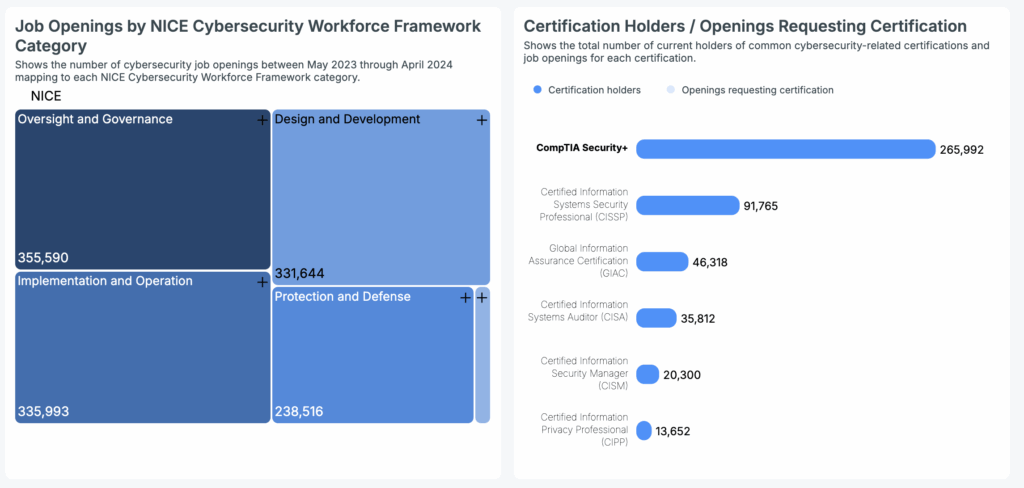
CyberSeek summarizes certification signals from job postings and reports the relationship between openings requesting certifications and certification-holder counts.
Yes. Kansas projections materials list Information Security Analysts among higher-growth occupations and report 15 average annual openings statewide in a projections summary, while CyberSeek shows ongoing job posting activity.
Yes. An associate degree can be an efficient starting point if it includes hands-on labs and a clear transfer path into a bachelor’s cybersecurity or computing program.
Associate: ~2 years
Bachelor’s: ~4 years
Master’s: ~1–2 years (depending on background and format)
Kansas participation can change year to year. Verify current participating institutions using the official SFS directory.
Kansas demand is commonly tied to government, healthcare, finance/insurance, manufacturing, and critical infrastructure employers—reflected in statewide hiring signals surfaced via CyberSeek’s state/metro views.
Entry-level roles commonly include SOC analyst, junior security analyst, and security operations support. Programs that include supervised practicums, competitions, or center-based outreach/training can help build experience before graduation.
Sources
- Bureau of Labor Statistics | Kansas — State Occupational Employment and Wage Estimates | Accessed February 19, 2026
- CyberSeek | Cybersecurity Supply/Demand Heat Map | Accessed February 19, 2026
- Kansas Department of Labor – Labor Market Information Division | August 2025 Projections Data Report | Accessed February 19, 2026
- Kansas Office of Information Technology Services | About OITS | Accessed February 19, 2026
- Kansas Office of Information Technology Services (OITS) / KISO | Kansas Cybersecurity Task Force | Accessed February 19, 2026
- CyberCorps® Scholarship for Service (SFS) | Participating schools directory | Accessed February 19, 2026
- University of Kansas – ITTC | KU Center of Academic Excellence in Cyber Defense and Research | Accessed February 19, 2026
- Emporia State University | Cybersecurity Research and Outreach Center | Accessed February 19, 2026
- Kansas State University | Center for Cybersecurity and Trustworthy Systems | Accessed February 19, 2026