- Associate degree
- Bachelor’s degree
- Master’s degree
- Cybersecurity certifications
- Indiana Cybersecurity initiatives
- FAQs
Students exploring cybersecurity degree options in Indiana can find a variety of academic pathways connected to employer demand in finance, defense contracting, insurance, and healthcare.
This page concentrates on degree and school options and mentions institutions only when they offer distinctive workforce partnerships, research activity, or specialized training initiatives.
How we keep this page current
Content is reviewed using program verification and labor market data from the CyberSeek workforce map, the U.S. Bureau of Labor Statistics (BLS) OEWS, Indiana’s state/partner projection feeds surfaced through O*NET Local Trends for Indiana, Indiana’s statewide cybersecurity resources such as the Indiana Executive Council on Cybersecurity, and the federal CyberCorps®: Scholarship for Service (SFS) participating institutions directory.
Program- or initiative-specific claims are verified against official institutional or state pages before inclusion, and time-sensitive claims are updated or removed when they cannot be re-verified.
Ad
cybersecurityguide.org is an advertising-supported site. Clicking in this box will show you programs related to your search from schools that compensate us. This compensation does not influence our school rankings, resource guides, or other information published on this site.
Featured Cybersecurity Degree Programs
| School Name | Program | More Info |
|---|---|---|
| Purdue Global | Online BS in Cybersecurity | website |
| Indiana Wesleyan University | Online BS in Cybersecurity | website |
| Southern New Hampshire University | Online BS in Cybersecurity or Online MS in Cybersecurity | website |
| UC Berkeley School of Information | Master’s in Cybersecurity | No GRE/GMAT Required | website |
Related resources
Cybersecurity workforce demand in Indiana
CyberSeek provides a state-level view of cybersecurity job-posting activity and supply/demand indicators for Indiana via its interactive heat map. Because CyberSeek is based on online job postings, it should be interpreted as a demand signal (postings), not a count of people employed in cybersecurity.
For employment and wages, BLS OEWS reports that Indiana employs about 1,490 Information Security Analysts with a mean annual wage of $102,690. As a cyber-adjacent occupation that often serves as an entry point to security work, Indiana employs about 4,740 Computer Network Support Specialists with a mean annual wage of $69,960.
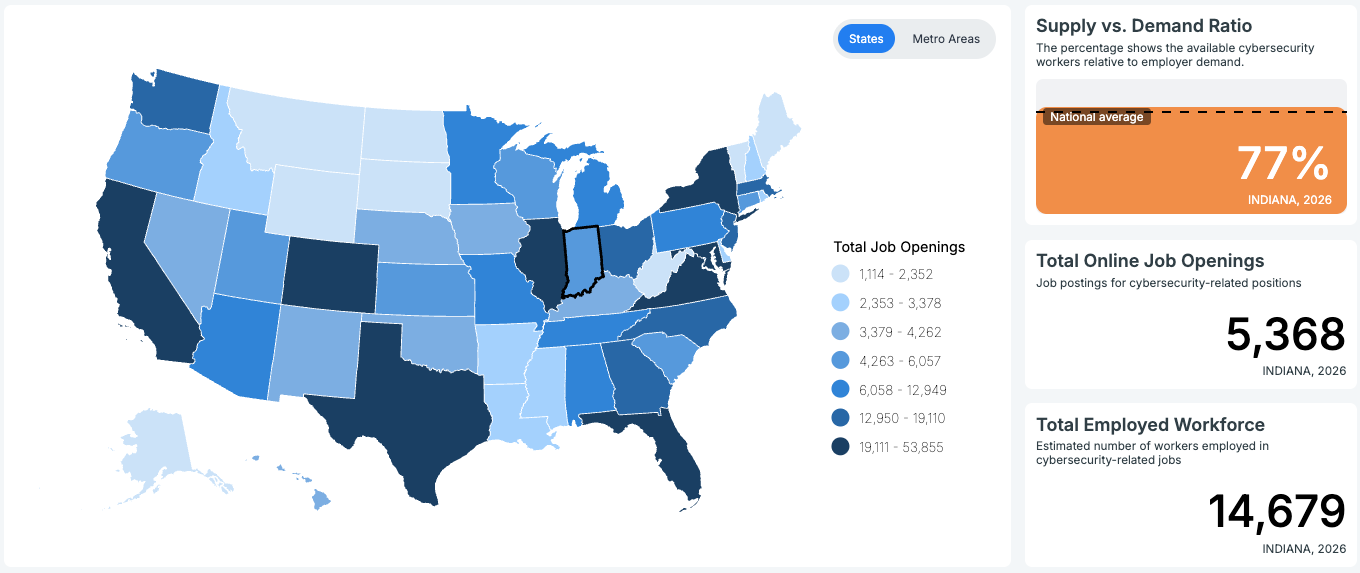
For projections/openings, O*NET’s Indiana local trends page estimates 1,150 Information Security Analysts employed in 2022, 1,570 in 2032, and about 120 projected annual openings in Indiana.
What these metrics do and do not mean:
- Postings can rise or fall quickly and may include reposts; they reflect hiring activity, not headcount.
- Employment/wages estimate the size and pay of the current workforce.
- Projections/openings estimate future demand from growth and replacement and depend on the projection period and methods.
Cybersecurity degree pathways in Indiana
Indiana students can enter cybersecurity through multiple educational routes. The goal is to choose a pathway that matches your starting point (new to IT vs. experienced) and your target roles (technical operations vs. governance/risk vs. research).
Associate degrees
Associate degrees are a common “on-ramp” for learners who want faster entry to IT and security-adjacent roles while building credentials toward a bachelor’s.
What to look for in an Indiana associate pathway:
- Clear transfer/ladder options into a bachelor’s program
- Coursework that builds networking + systems fundamentals first (the foundation for most security work)
- Hands-on labs (physical or well-structured virtual labs)
Ivy Tech Community College
Indianapolis, Indiana Program: Cyber Security / Information Assurance
CAE designation: CAE-CD
Credits: 33
Cost per credit: $170
Delivery method: Campus & online
Learn more: Program detailsNational American University-Indianapolis
Indianapolis, IndianaProgram: Online Information Technology Associate Program - Computer Security
Credits: 93
Cost per credit: $380
Delivery Method: Online
Learn more: Program details
Bachelor’s degrees
Bachelor’s degrees are a frequent requirement for analyst roles and are especially valuable when paired with applied experiences (labs, internships, security operations exposure, or clinics).
Campus-based bachelor’s degree
Anderson University
Anderson, IndianaProgram: Cybersecurity Major
Credits: 120
Cost per credit: $1,102
Delivery method: On campus
Learn more: Program detailsIndiana Tech
Fort Wayne, IndianaProgram: Cybersecurity, B.S.
Credits: 121
Cost per credit: $606
Delivery method: On campus & online
Learn more: Program detailsIndiana University Bloomington
Bloomington, IndianaProgram: B.S. in Cybersecurity and Global Policy
CAE designation: CAE-CD, CAE-R
Credits: 120
Cost per credit: $313 in-state | $1,178 out-of-state
Delivery method: On-campus
Learn more: Program detailsPurdue University
West Lafayette, IndianaProgram: Bachelor of Science in Computer and Information Technology – Cybersecurity
CAE designation: CAE-CD
Credits: 120
Cost per credit: $323 in-state | $627 out-of-state
Delivery Method: On campus
Learn more: Program detailsPurdue University-Northwest
Hammond, IndianaProgram: Bachelor's Degree in Cybersecurity
CAE designation: CAE-CD
Credits: 120
Cost per credit: $272 in-state | $395 out-of-state
Delivery method: On-campus
Learn more: Program details
Online bachelor’s degree
Indiana Tech
Fort Wayne, IndianaProgram: Cybersecurity, B.S.
Credits: 121
Cost per credit: $606
Delivery method: On Campus & Online
Learn more: Program detailsPurdue Global
Indianapolis, INProgram: Bachelor of Science in Cybersecurity
Credits: 180
Cost per credit: $420
Delivery method: Online
Learn more: Program details
Distinctive, Indiana-based examples of applied learning and research ecosystems:
- Indiana University’s Cybersecurity Clinic, which is designed to provide pro bono cybersecurity support to under-resourced organizations while training students through real-world engagements.
- Purdue’s Center for Education and Research in Information Assurance and Security (CERIAS), an interdisciplinary security research and education institute that supports ongoing seminars, events, and security-focused community engagement.
Master’s degrees
Master’s programs can help with specialization (incident response, forensics, security engineering) or advancement into governance/risk leadership.
A distinctive applied-learning signal to look for—especially for working adults—is whether the program ecosystem includes structured mentorship, clinics, or applied research opportunities connected to employers or community entities (for example, IU’s cybersecurity programs highlight clinic/community and advisory support elements).
PhD degrees
A doctoral degree in cybersecurity (Ph.D.) is the highest degree in the field. It’s primarily meant for individuals who would like to work in academia, for one of America’s three-letter agencies, or at the highest levels in a company.
Indiana University Bloomington
Bloomington, IndianaProgram: Ph.D. in Informatics – Security Informatics Track
Credits: 90
Cost per credit: $1,960 in state | $2,198 out of state
Delivery Method: Campus
GRE/GMAT Required: Not Required
Learn more: Program detailsPurdue University
West Lafayette, IndianaProgram: Interdisciplinary Ph.D. Program in Information Security
CAE designation: CAE-R
Credits: 90
Cost per credit: $607 in state | $1175 out of state
Delivery Method: Campus
GRE/GMAT Required: Required
Learn more: Program detailsPurdue University
West Lafayette, IndianaProgram: Ph.D. in CS with an Info-Security Focus
CAE designation: CAE-R
Credits: 90
Cost per credit: $607 in state | $1175 out of state
Delivery Method: Campus
GRE/GMAT Required: Not Required
Learn more: Program details
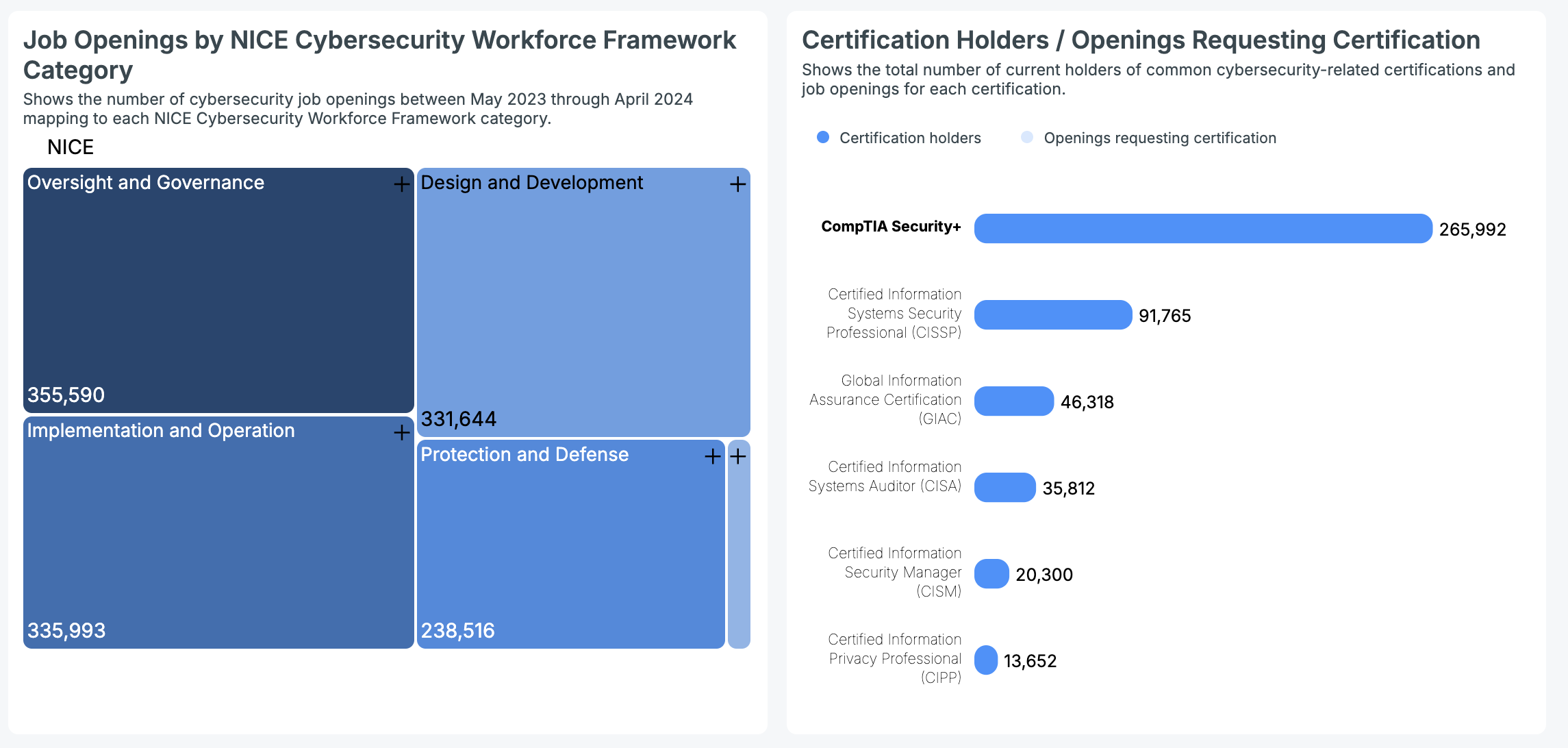
Certifications and workforce programs
Shorter training options can help career changers or working professionals build specific job-ready skills. Indiana’s statewide cybersecurity hub includes a workforce development page that points learners to training resources such as FedVTE (a DHS-managed training platform for eligible audiences) and other state-curated training links.
Ivy Tech Community College
Indianapolis, IndianaProgram: Cyber Security / Information Assurance - CERT
CAE designation: CAE-CD
Credits: 33
Cost per credit: $170
Delivery Method: Campus, Online
Learn more: Program detailsMyComputerCareer.edu-Indianapolis
Indianapolis, IndianaProgram: Cyber Security Specialist (CSS) - CERT
Credits: 30-42 weeks
Cost per credit: $587
Delivery Method: Campus, Online
Learn more: Program detailsPurdue University Northwest
Hammond, IndianaProgram: Post Baccalaureate Certificate in Cybersecurity
CAE designation: CAE-CD
Credits: 12
Cost per credit: $502 in state | $629 out of state
Delivery method: Campus
Learn more: Program details
Scholarship for Service
CyberCorps®: Scholarship for Service (SFS) provides scholarships for cybersecurity students in exchange for government service after graduation.
Indiana-specific examples of SFS program pages include Indiana University’s CyberCorps materials. Note that some institutions may have had SFS funding in prior years but not currently; always confirm current application status on the official program page and/or the SFS directory.
Unique Indiana cybersecurity initiatives
- Indiana Executive Council on Cybersecurity (IECC): Indiana maintains a cross-sector executive council focused on statewide cyber risk priorities and strategy.
- Indiana cybersecurity workforce development resources: Indiana’s cybersecurity hub curates training/workforce development resources for government and the broader community.
- Indiana Office of Technology (IOT) awareness training goal: IOT describes the goal of its cybersecurity awareness training program as reducing human error and strengthening workforce resilience for Indiana government services.
- University-affiliated clinic model supporting local pipelines: Indiana University’s Cybersecurity Clinic model is designed to both improve cyber hygiene for under-resourced entities and train students through real client engagements.
Frequently asked questions about cybersecurity degrees in Indiana
BLS estimates Indiana employs about 1,490 Information Security Analysts. CyberSeek provides a separate view of online job postings for cybersecurity roles, which is not the same as employment.
BLS reports a mean annual wage of $102,690 for Information Security Analysts in Indiana.
There isn’t a single “best” degree for everyone. A strong choice is typically a bachelor’s degree that includes hands-on security learning (labs, internships, operations exposure, clinics). In Indiana, examples of distinctive applied ecosystems include Purdue’s CERIAS and Indiana University’s Cybersecurity Clinic.
Yes—many Indiana students use online or hybrid formats (either in-state or accredited out-of-state). If you choose online, verify accreditation and ensure the program includes structured labs and a capstone/practicum.
Indiana’s cybersecurity hub curates training options and points to resources such as FedVTE for eligible learners, along with other training links.
Indiana-specific “most requested certifications” can vary by employer and role, and there isn’t a single official statewide table that stays current. A practical approach is to review current Indiana postings using CyberSeek’s workforce tools and your target employers’ job descriptions.
Yes. CyberSeek’s heat map reflects ongoing cybersecurity job-posting activity for Indiana (postings-based demand signal), and state projections estimate continued openings for Information Security Analysts (annual openings include growth and replacement).
Yes. Many students start with an associate degree to build IT foundations, then transfer into a bachelor’s program to deepen security specialization.
– Associate degree: 2 years
– Bachelor’s degree: 4 years
– Master’s degree: 1–2 years beyond a bachelor’s
Yes. CyberCorps® SFS is a national program with participating institutions listed in the federal directory, and Indiana institutions appear in that directory; always confirm current status on the official directory and the institution’s program page.
Cybersecurity graduates are hired across government, healthcare, manufacturing, finance/insurance, education, and professional/technical services. For a grounded view of role presence in Indiana, BLS provides employment estimates for Information Security Analysts and related IT roles like Computer Network Support Specialists.
Yes—entry-level pathways often begin in security-adjacent roles (network support, systems administration) that build experience toward analyst roles. BLS shows Indiana employment for roles like Computer Network Support Specialists, which commonly align with early-career pathways.
Look for programs that explicitly offer clinics, operations-center style work, applied labs, or community/employer engagements. For example, Indiana University’s Cybersecurity Clinic is structured around real organizations and student consulting engagements.
Sources
- CyberSeek | Cybersecurity Supply/Demand Heat Map | Accessed March 2, 2026
- U.S. Bureau of Labor Statistics | Occupational Employment and Wage Statistics | Accessed March 2, 2026
- O*NET OnLine | Information Security Analysts (Indiana) | Accessed March 2, 2026
- State of Indiana | Indiana Executive Council on Cybersecurity | Accessed March 2, 2026
- State of Indiana | Workforce Development for Cybersecurity | Accessed March 2, 2026
- State of Indiana | Indiana Office of Technology – Statewide Training Resources | Accessed March 2, 2026
- U.S. Office of Personnel Management | Scholarship for Service – Participating Institutions | Accessed March 2, 2026
- Purdue University | CERIAS | Accessed March 2, 2026
- Indiana University | IU Cybersecurity Clinic | Accessed March 2, 2026
- IU CyberCorps |CyberCorps program page | Accessed March 2, 2026