- Associate degrees
- Bachelor’s degrees
- Master’s degrees
- Cybersecurity certifications
- Hawaii Cybersecurity initiatives
- FAQs
A strong cybersecurity education page should do more than list schools — it should connect degree options to verified workforce demand and credible public data.
Students looking into cybersecurity degree programs in Hawaii will find college pathways aligned with hiring demand across finance, defense contracting, insurance, and healthcare.
This page focuses specifically on academic pathways and school-based opportunities. Institutions are referenced only when they operate distinctive workforce, research, or training initiatives that add meaningful value beyond a standard program listing.
How we keep this page current
We maintain this page using data and program verification from CyberSeek, the U.S. Bureau of Labor Statistics, Hawaiʻi’s labor market and projections publications from the Hawaiʻi Department of Labor and Industrial Relations (DLIR), the State’s Office of Enterprise Technology Services (ETS) cybersecurity program, and the federal CyberCorps®: Scholarship for Service.
Institution-level claims are verified through official university initiatives or research center pages, and time-sensitive information is periodically rechecked and removed when outdated.
Ad
cybersecurityguide.org is an advertising-supported site. Clicking in this box will show you programs related to your search from schools that compensate us. This compensation does not influence our school rankings, resource guides, or other information published on this site.
Featured Cybersecurity Degree Programs
| School Name | Program | More Info |
|---|---|---|
| Southern New Hampshire University | Online BS in Cybersecurity or Online MS in Cybersecurity | website |
| Grand Canyon University | Online BS in Cybersecurity or Online MS in Cybersecurity | website |
| UC Berkeley School of Information | Master’s in Cybersecurity | No GRE/GMAT Required | website |
| Eastern Oregon University | Online BS in Cybersecurity | website |
| Purdue Global | Online BS in Cybersecurity | website |
Cybersecurity workforce demand in Hawaii
Cybersecurity hiring in Hawaii is influenced by government operations, defense-adjacent employers, healthcare providers, and organizations that support critical infrastructure.
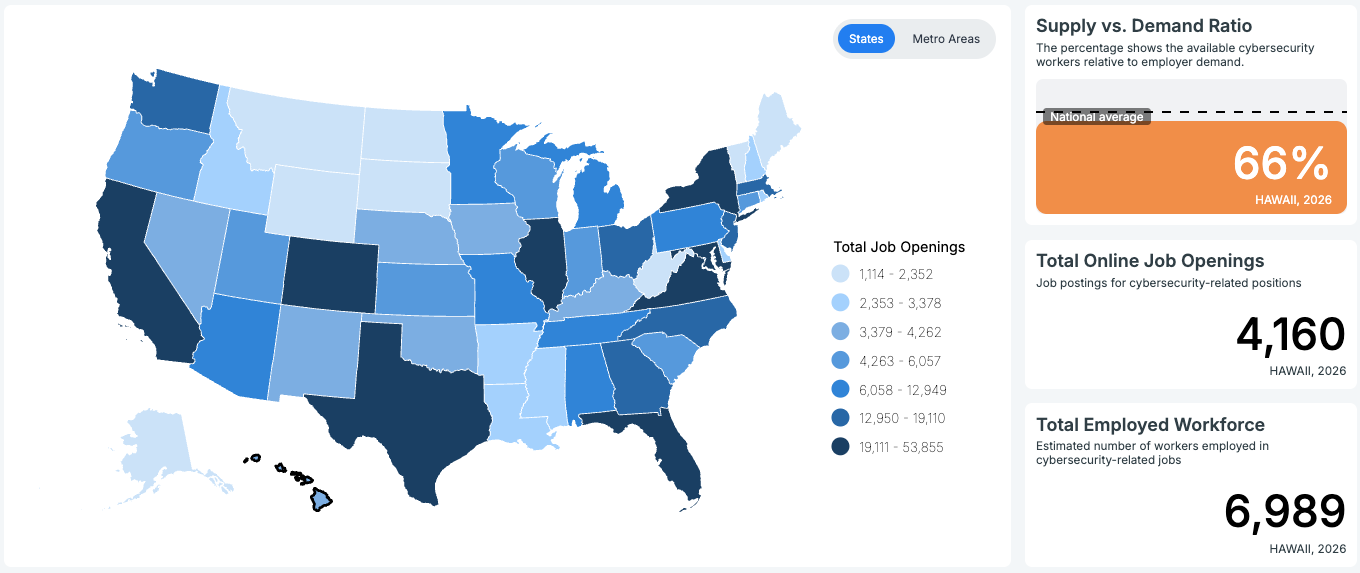
CyberSeek’s state-level heat map provides a snapshot of cybersecurity job-posting activity and workforce supply/demand indicators for Hawaii. CyberSeek data is based on online job postings and is best interpreted as a demand signal, not a count of employed workers.
For employment and wages, the BLS Occupational Employment and Wage Statistics (OEWS) provides state estimates. In Hawaii, BLS reports about 390 Information Security Analysts employed with a mean annual wage of $113,820. As a closely related cyber-adjacent occupation, BLS reports about 500 Computer Network Support Specialists employed in Hawaii with a mean annual wage of $72,670.
For projections, Hawaii DLIR published long-term occupational projections for 2016–2026, indicating Information Security Analysts growing from 220 (2016) to 260 (2026) with ~20 annual average openings. DLIR has also announced updated statewide forecasts through 2032, but the detailed occupation tables for 2022–2032 were not accessible from the official hosting site in our review environment; to avoid guessing, this page does not report occupation-specific 2022–2032 numbers.
How to interpret these metrics: job postings indicate hiring activity and may include reposts or hard-to-fill roles, while OEWS employment/wage estimates describe the size and compensation of the existing workforce. Projections estimate future openings from growth and replacement, but should be read with attention to the projection period and methodology.
Related resources
Cybersecurity degree pathways in Hawaii
Hawaii students can pursue cybersecurity through academic degrees and workforce training. Because programs are spread across islands and many learners are working adults, hybrid and online options can be especially relevant.
Associate degrees
Associate degrees are often the fastest college pathway into security-adjacent roles and typically emphasize IT foundations (networks, operating systems, scripting) plus introductory security concepts.
Honolulu Community College
Honolulu, Hawaii Program: Associate of Science in CENT – Information Assurance
Credits: 60
Cost per credit: $131 in state | $345 out of state
Delivery Method: Campus
Learn more: Program detailsLeeward Community College
Pearl City, HawaiiProgram: Associate in Science, Information and Computer Science - Information Security
CAE designation: CAE-CD
Credits: 60
Cost per credit: $131 in state | $345 out of state
Delivery Method: Campus
Learn more: Program details
What to look for in Hawaii associate pathways:
- Certification preparation options where clearly stated by the provider
- Hands-on labs (or structured virtual labs)
- Coursework mapped to security fundamentals
- Advising that supports transfer to a four-year cybersecurity or IT bachelor’s program
Bachelor’s degrees
Bachelor’s degrees are a common baseline for many cybersecurity roles and typically include deeper coverage of security engineering, secure networking, and applied defensive techniques.
A distinctive option in Hawaii is the University of Hawaiʻi–West Oʻahu (UHWO) cybersecurity ecosystem, including its B.S. in Cybersecurity and the Cyber Security Coordination Center (CSCC), which is designed to give students experience working in a cyber operations center and coordinating cyber defense information with partners.
University of Hawaii at Manoa
Honolulu, HawaiiProgram: Bachelor of Arts in Information and Computer Sciences – Security Science Track
CAE designation: CAE-R
Credits: 120
Cost per credit: $471 in-state | $1,389 out-of-state
Delivery Method: Campus
Learn more: Program detailsUniversity of Hawaii at Manoa
Honolulu, HawaiiProgram: Bachelor of Science in Computer Science – Security Science Track
CAE designation: CAE-R
Credits: 120
Cost per credit: $471 in-state | $1,389 out-of-state
Delivery Method: Campus
Learn more: Program detailsUniversity of Hawaii-West Oahu
Kapolei, HawaiiProgram: Bachelor of Applied Science in Information Security and Assurance
CAE designation: CAE-CD
Credits: 126
Cost per credit: $233 in-state | $645 out-of-state
Delivery Method: Campus
Learn more: Program details
When comparing bachelor’s programs, prioritize:
- Coverage of networking, systems, and security together (not security in name only)
- Documented experiential learning (operations center work, labs, practicum)
- Clear pathways to internships or applied projects
Master’s degrees
Master’s programs can support advancement into specialized technical roles (security engineering, incident response, forensics) or governance/leadership tracks (risk management, policy).
In Hawaii, students often combine graduate study with employer experience. If you’re choosing a master’s pathway, look for:
- Advanced coursework with hands-on assessments (labs, projects, capstones)
- Alignment to the roles you want (technical vs. governance vs. research)
- Faculty or lab initiatives that support applied work when available
Certifications and workforce programs
Workforce training and certifications can provide a faster route into entry-level security-adjacent roles or help IT professionals transition into security responsibilities.
One distinctive workforce option is the Hawaii Immersive Workforce (HIW) Project led through UH Maui College, described as a skills-based cybersecurity workforce development program supported through a partnership agreement and grant-funded training effort.
Scholarship for Service
CyberCorps®: Scholarship for Service (SFS) funds cybersecurity students in exchange for government service after graduation. Hawaii has an SFS-participating institution: University of Hawaiʻi at Mānoa, as listed by the federal SFS participating institutions directory. UH Mānoa also maintains an SFS program page with recruiting and program information.
Unique Hawaii cybersecurity initiatives
Hawaii’s cybersecurity education landscape includes several statewide and institution-led initiatives that can support student pipelines.
- State of Hawaiʻi Cybersecurity Program (ETS): ETS describes its cybersecurity program mission as protecting the confidentiality, integrity, and availability of electronic information resources for the State’s Executive Branch and serving as a centralized cybersecurity resource.
- UH West Oʻahu Cyber Security Coordination Center (CSCC): CSCC is designed to provide students the opportunity to work in a cyber operations center environment and coordinate cyber defense information with partners.
- UH Maui College Hawaii Immersive Workforce (HIW) Project: Described as a workforce development program to train participants for critical infrastructure sectors, with public information available through UH Maui College and UH system communications.
Frequently asked questions about cybersecurity degrees in Hawaii
For the employed workforce size, the BLS estimates about 390 Information Security Analysts in Hawaii. For hiring activity, CyberSeek provides state-level job posting indicators for Hawaii.
BLS reports a mean annual wage of $113,820 for Information Security Analysts in Hawaii.
There isn’t a single “best” degree for everyone. In general, a bachelor’s degree with documented hands-on training (labs, operations-center experience, practicum/capstone) is a strong baseline. For example, UH West Oʻahu’s CSCC is intended to provide cyber operations center experience for students.
Yes. Many Hawaii students use online and hybrid formats (either in-state or through accredited out-of-state programs). If you choose online, confirm accreditation and look for structured labs and a capstone or practicum.
Hawaii offers short-term training options, including workforce initiatives such as the UH Maui College Hawaii Immersive Workforce (HIW) Project, described as a skills-based training program.
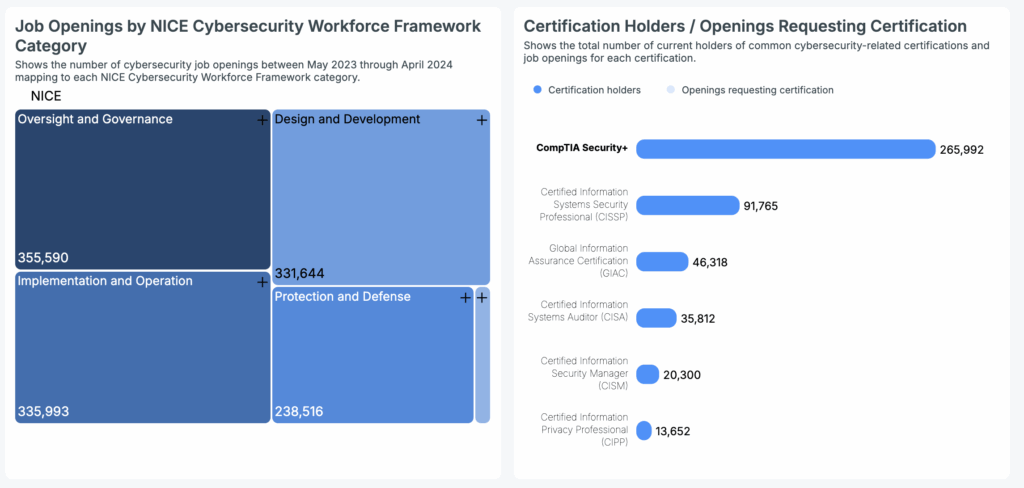
Certification demand varies by employer and role, and CyberSeek provides national career pathway information and job-market context used by educators and jobseekers. For entry-level roles, Security+-aligned coursework is commonly pursued; always validate what local employers request in postings.
CyberSeek’s Hawaii heat map shows ongoing cybersecurity job-posting activity, which signals continued employer demand.
Yes. Many students start with an associate degree to build IT fundamentals, then transfer into a bachelor’s program for deeper security specialization.
– Associate degree: ~2 years
– Bachelor’s degree: ~4 years
– Master’s degree: ~1–2 years beyond a bachelor’s
Yes. The federal SFS directory lists University of Hawaiʻi at Mānoa as a participating institution, and UH Mānoa maintains a program site.
Cybersecurity graduates are commonly hired across government, defense-adjacent contractors, healthcare, education, utilities, and financial services. BLS occupational estimates provide statewide context for cyber and cyber-adjacent roles (for example, Information Security Analysts and Computer Network Support Specialists).
Yes. Entry-level opportunities often begin in security-adjacent roles (network support, systems administration) that build experience toward analyst roles; BLS reports employment for roles such as Computer Network Support Specialists in Hawaii.
Look for explicit statements about labs, operations-center experience, internships, or applied centers. For example, UH West Oʻahu’s CSCC describes a cyber operations center experience designed to prepare students for employment.
Sources
- CyberSeek | Cybersecurity Supply/Demand Heat Map | Accessed March 2, 2026
- U.S. Bureau of Labor Statistics| Occupational Employment and Wage Statistics | Accessed March 2, 2026
- Hawaiʻi Department of Labor and Industrial Relations | Long-Term Occupational Projections-State of Hawaiʻi | Accessed March 2, 2026
- Hawaiʻi Department of Labor and Industrial Relations | State Releases Forecast for Jobs and Industries | Accessed March 2, 2026
- State of Hawaiʻi, Office of Enterprise Technology Services |State of Hawaiʻi Cybersecurity Program | Accessed March 2, 2026
- Scholarship for Service | Participating Institutions | Accessed March 2, 2026
- University of Hawaiʻi at Mānoa | UHM CyberCorps SFS program | Accessed March 2, 2026
- University of Hawaiʻi–West Oʻahu | Cyber Security Coordination Center | Accessed March 2, 2026
- UH Maui College | Hawaii Immersive Workforce Project | Accessed March 2, 2026
- University of Hawaiʻi News | Free cybersecurity training through UH Maui College | Accessed March 2, 2026