- Associate degree
- Bachelor’s degree
- Master’s degree
- Cybersecurity certifications
- Arkansas Cybersecurity Initiatives
- FAQs
If you’re searching for a cybersecurity degree in Arkansas, the best starting point is to match your program level (associate, bachelor’s, master’s, or certificate) to the kind of role you want, and then sanity-check the local job market.
Arkansas has a large employer footprint with a major corporate home office in Bentonville, plus statewide efforts to coordinate cybersecurity planning and workforce development. (And yes, you can do this without falling into “general tech jobs” content.)
How we keep this page current
We update Arkansas workforce demand and wage references using CyberSeek for job-posting demand context and the Bureau of Labor Statistics for wage and employment estimates.
We also verify state initiatives using official Arkansas government sources and enacted legislation.
This page is reviewed on a regular cadence, and we remove time-sensitive claims that cannot be verified with primary sources.
Ad
cybersecurityguide.org is an advertising-supported site. Clicking in this box will show you programs related to your search from schools that compensate us. This compensation does not influence our school rankings, resource guides, or other information published on this site.
Featured Cybersecurity Degree Programs
| School Name | Program | More Info |
|---|---|---|
| Arkansas State University | Online BS in Digital Technology - Cloud Computing & Cybersecurity | website |
| Purdue Global | Online BS in Cybersecurity | website |
| UC Berkeley School of Information | Master’s in Cybersecurity | No GRE/GMAT Required | website |
| Grand Canyon University | Online BS in Cybersecurity or Online MS in Cybersecurity | website |
| Southern New Hampshire University | Online BS in Cybersecurity or Online MS in Cybersecurity | website |
Cybersecurity workforce demand in Arkansas
Cybersecurity hiring demand is often measured indirectly through job postings and occupation counts, and the two don’t match perfectly. Job postings can include duplicates, staffing-firm posts, and roles that blend security with other IT responsibilities, while occupational counts are survey-based.
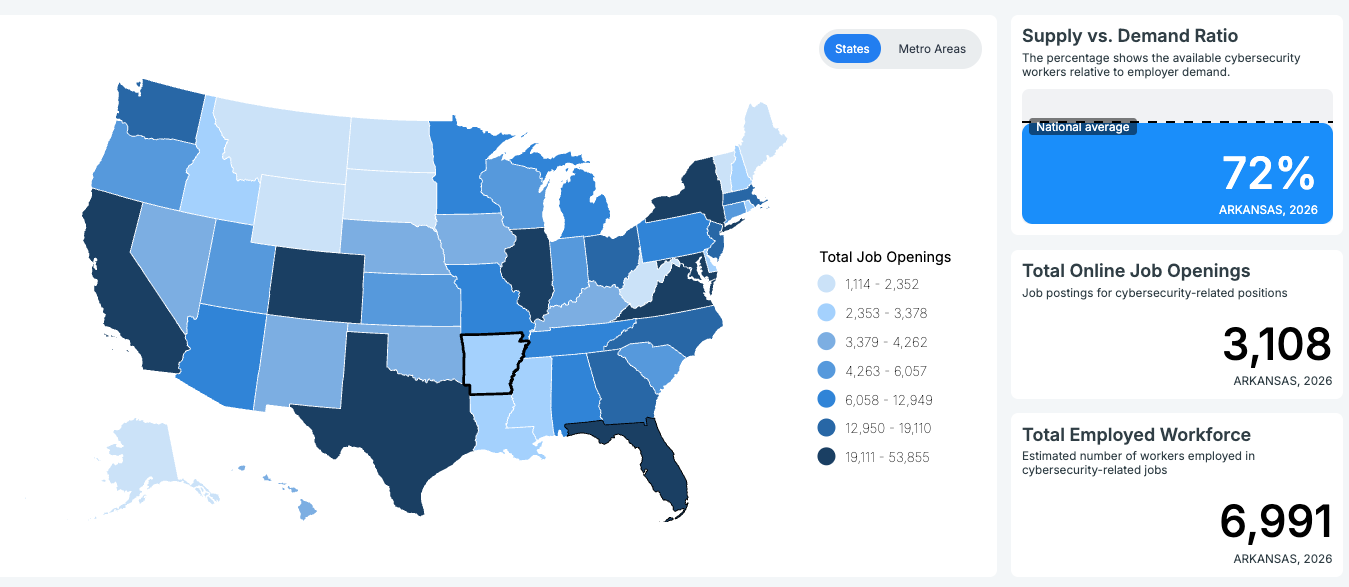
CyberSeek-referenced reporting from the University of Arkansas at Little Rock notes that Arkansas has more than 3,000 cybersecurity job openings in recent periods. (That figure is attributed to CyberSeek’s job-posting-based approach).
For wages and a clean occupation definition, the Bureau of Labor Statistics’ Occupational Employment and Wage Statistics (OEWS) estimates that Arkansas employs about 1,140 information security analysts (SOC 15-1212), with a mean hourly wage of $43.98 and a mean annual wage of $93,150 (May 2023).
What to take from this if you’re choosing a degree program:
- Job postings suggest steady employer demand for security skills in Arkansas.
- BLS wage and employment estimates provide a grounded benchmark for “information security analyst” roles specifically, which are often a target outcome for degree pathways.
- Arkansas also publishes labor market information tools (including projections tables) through the state LMI portal, which can be useful for cross-checking demand by occupation group.
Cybersecurity degree pathways in Arkansas
This section focuses on degree and school-related pathways. We mention institutions only when there is a clear, sourceable initiative that goes beyond generic “we offer a degree” listings.
Associate degrees
Associate degrees are typically a fit if you want a faster on-ramp into IT support, networking, or junior security operations roles, with a plan to stack additional certifications or transfer into a bachelor’s program.
Arkansas Tech University
Russellville, AR Program: Associate of Applied Science in Cybersecurity
CAE designation: CAE-CD
Credits: 60
Cost per credit: $239 in state | $278 out of state
Delivery method: Campus
Program highlights:- Goal: Train students to both hack and protect computer systems.
- What You'll Learn: Basics of coding, wireless tech, math, and network setup. The course blends theory with hands-on practice.
- Course Content: Encompasses courses in programming, wireless technologies, mathematics, and networking.
Northwest Arkansas Community College
Bentonville, ARProgram: AAS in Computer Information Systems - Option Networking
Credits: 66
Cost per credit: $79 in state | $164 out of state
Delivery method: Campus
Program highlights:- Jobs: Graduates can work as computer technicians, network administrators, help desk analysts, and more.
- Accreditation: The college's computer programs, except for CAD, are accredited by a recognized council since 2014.
- Additional Certifications: Provides a technical certificate in networking and cyber security.
Bachelor’s degrees
Bachelor’s degrees are often the default credential for entry-level analyst roles and for structured internships. In Arkansas, one example of “beyond the degree listing” activity is UA Little Rock’s Cyber Arena, which provides scalable, hands-on cybersecurity training exercises.
Campus-based bachelor’s degree
Southern Arkansas University Main Campus
Magnolia, ARProgram: Bachelor of Science in Computer Science – Privacy and Cyber Security Option
Credits: 120
Cost per credit: $240 in state | $426 out of state
GRE/GMAT Required: Not Required
Delivery method: Campus, Hybrid
Program highlights:- Overview: Students learn both theory and practical skills to tackle cyber threats and ensure privacy. The program also covers the latest trends in these fields.
- Specialized Subjects: Privacy Engineering, Cyber Forensics, and Cyber Defense.
- Note: No need to choose a minor subject.
Arkansas Tech University
Russellville, ARProgram: Bachelor of Science in Cybersecurity
Credits: 120
Cost per credit: $250 in state | $500 out of state
GRE/GMAT Required: Not Required
Delivery method: Campus
Program highlights:- Course Aim: Understand online threats and how to defend against them.
- Subjects: Learn to create secure networks and understand hacking methods.
- Feedback: Most graduates see the degree as a good investment.
University of Arkansas at Little Rock
Little Rock, ARProgram: Bachelor of Science in Cybersecurity
CAE designation: CAE-CD
Credits: 120
Cost per credit: $235 in state | $635 out of state
GRE/GMAT Required: Not Required
Delivery method: Campus
Program highlights:- Expert Teachers: The program's teachers have real-world experience and are dedicated to helping students learn about cybersecurity.
- Practical Training: Students can practice their skills in the Trojan Cyber Arena, a safe online space.
- Job Opportunities: Cybersecurity jobs are in high demand, with a median salary of $112,000 in 2022.
Online bachelor’s degree
Southern Arkansas University Main Campus
Magnolia, ARProgram: Bachelor of Science in Computer Science – Privacy and Cyber Security Option
Credits: 120
Cost per credit: $240 in state | $426 out of state
GRE/GMAT Required: Not Required
Delivery method: Campus, Hybrid
Program highlights:- About the Program: Students learn the theory behind cyber security and get practical training to stop cyber threats.
- Overview: Offers students a dual and complementary expertise in cyber security and privacy.
- Program Study: They will study how to make systems that respect user privacy.
Master’s degrees
Master’s degrees tend to be most valuable when they map to leadership, architecture, or specialized roles (security engineering, cloud security, governance/risk). If you’re evaluating master’s programs, look for applied labs, partnerships, or research centers with a clear security scope.
Southern Arkansas University Main Campus
Magnolia, ARProgram: Master of Science in Computer and Information Science – Cyber Security and Privacy Option
Credits: 30
Cost per credit: $312 in state | $490 out of state
GRE/GMAT Required: Not Required
Delivery method: Online
Program highlights:- Cyber Security Track: Learn about online safety, data protection, and privacy rules.
- Coursework: 30 hours of classes, including core subjects and specialized Cyber Security courses, plus elective options.
- Overview: Southern Arkansas University offers a Master's program in Computer Science, which is both affordable and comprehensive.
Strayer University-Arkansas
Little Rock , ARProgram: Master of Science in Information Systems (MSIS) - Computer Security Management
Credits: 30
Cost per credit: $830
GRE/GMAT Required: Not Required
Delivery method: Online
Program highlights:- Course Content: Learn to defend against hackers, design firewalls, and understand security tools.
- Accreditation: Recognized by the Middle States Commission on Higher Education.
- Alumni Views: 75% of graduates found the degree valuable, based on a 2021 survey.
Strayer University-Arkansas
Little Rock , ARProgram: Online Master of Science in Information Security and Assurance
Credits: 30
Cost per credit: $830
GRE/GMAT Required: Not Required
Delivery method: Online
Program highlights:- Certifications: The program prepares students for specific industry exams.
- Meets U.S. Standards: It follows U.S. guidelines for cybersecurity training.
- About the Program: Teaches students how to protect against cyber threats.
Certifications and workforce programs
Certifications can complement a degree by signaling specific job readiness (for example, baseline security knowledge, cloud security, or hands-on incident response). Instead of listing national “holder” totals (which change and are often not comparable across issuers), this page treats certifications as stackable signals alongside degrees.
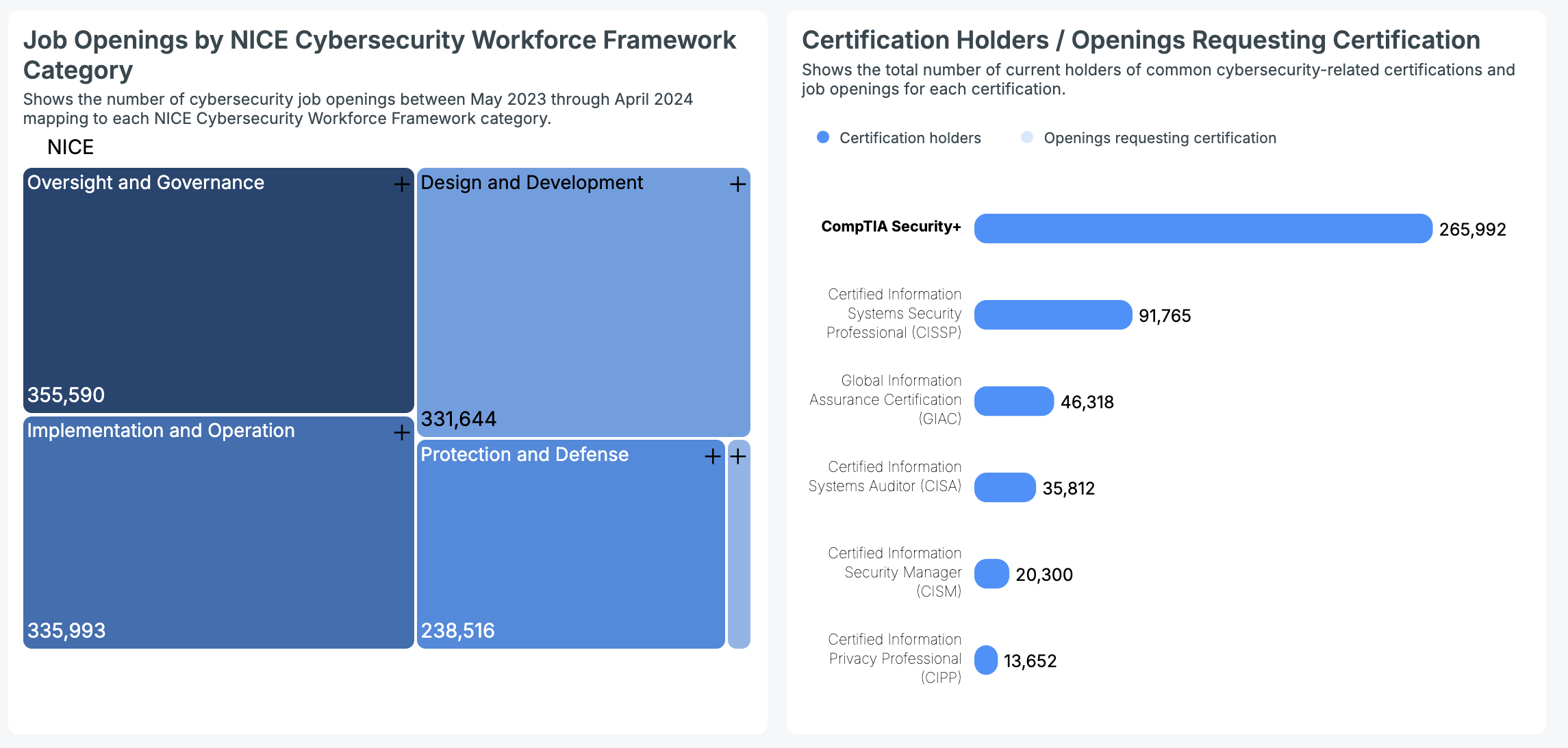
If you’re trying to pick a practical starter set, treat your degree as the core and choose certifications that align to the first role you want (SOC analyst, security analyst, cloud security associate, GRC analyst).
CyberSeek’s heat map is one place employers and job seekers use to understand the broader demand/supply picture behind those role families.
Northwest Arkansas Community College
Bentonville, ARProgram: Technical Certificate in Networking and Cyber Security
CAE designation: CAE-CD
Credits: 34
Cost per credit: $79 in state | $164 out of state
Delivery method: Campus
Program highlights:- Skills: Students learn to design, set up, and fix computer networks.
- Certifications: The course prepares students for various IT exams like CCNA and CompTIA.
- Jobs: Graduates can become computer technicians, network admins, and other IT roles.
University of Arkansas
Fayetteville, ARProgram: Cybersecurity Graduate Certificate
CAE designation: CAE-R
Credits: 12
Cost per credit: $219 in state | $595 out of state
Delivery method: Campus
Program highlights:- Overview: Aims to provide students with the expertise to defend crucial data and hone a diverse set of security skills to anticipate and counteract cyber threats.
- Program: The institution emphasizes research, academics, and campus life, with a strong presence on various social media platforms.
- Events: The university also hosts various events and news updates, including wellness programs and employee spotlights.
University Of Arkansas at Little Rock
Little Rock, ARProgram: Cybersecurity Advanced Technical Certificate
CAE designation: CAE-CD
Credits: 29-30
Cost per credit: $345 in state | $740 out of state
Delivery method: Campus
Program highlights:- Program: The certificate offers a mix of tech-focused and ethical courses, ensuring a comprehensive cybersecurity education.
- Overview: Its structure is adaptable, catering to both immediate entry into the cybersecurity domain and those planning a longer academic route.
- Key Takeaway: The emphasis on ethics highlights the significance of ethical decision-making in cybersecurity operations.
University Of Arkansas at Little Rock
Little Rock, ARProgram: Cybersecurity Fundamentals Certificate of Proficiency
CAE designation: CAE-CD
Credits: 11-12
Cost per credit: $345 in state | $740 out of state
Delivery method: Campus
Program highlights:- Courses: Students will learn about computing, security, and ethics.
- Program: The course is short, just 11-12 hours.
- For Beginners: It's a great start for a cybersecurity career or to add to what an individual knows.
University of Arkansas Community College-Batesville
Batesville, ARProgram: Technical Certificate in Cybersecurity
Credits: 21
Cost per credit: $84 in state | $125 out of state
Delivery method: Campus
Program highlights:- Overview: Provides an in-depth study of cybersecurity, touching on various critical areas from safeguarding networks to understanding digital ethics.
- Experience: Enrolled students will be equipped with the necessary skills and knowledge to navigate the dynamic landscape of cybersecurity.
- Computer Ethics: Courses will help shape the perspective ethics of cybersecurity professionals.
University of Arkansas Community College-Batesville
Batesville, ARProgram: Certificate of Proficiency in Cybersecurity Fundamentals
Credits: 12
Cost per credit: $84 in state | $125 out of state
Delivery method: Campus
Program highlights:- Credit Structure: The entire program is designed to be completed in 12 credits, ensuring a concise yet comprehensive understanding of the subject matter.
- Core Curriculum: The program is structured around four primary courses, each contributing to the comprehensive understanding of cybersecurity.
- Program Department: The course is affiliated with the Computer Information Systems department, indicating a strong foundation in both computer systems and their security aspects.
Scholarship for service (SFS)
The NSF Scholarship for Service (SFS) program supports cybersecurity education tied to public-sector service commitments. Arkansas institutions appear in the NSF SFS award listings (check the NSF list for the most current award years and institutions).
Unique state cybersecurity initiatives
Arkansas has a mix of statutory, government, and ecosystem initiatives that can matter when you’re selecting a program (because they can translate into internships, practicums, and applied learning).
- State cybersecurity governance and services: Arkansas’s cybersecurity function is described through the state’s Department of Shared Administrative Services (State Technology/Cybersecurity), and its legal foundation was strengthened by the Arkansas Cybersecurity Act of 2025 (Act 489), which creates a State Cybersecurity Office and associated responsibilities.
- Fusion center: The Arkansas State Fusion Center is listed in the U.S. Department of Homeland Security fusion center directory, which matters for students interested in intelligence, threat information sharing, and public-sector security pathways.
- Hands-on training infrastructure: UA Little Rock’s Cyber Arena provides cloud-based “workouts” and exercises that can support applied learning and skills practice beyond standard coursework.
- Skills-based events and ecosystem activity: The Venture Center’s JOLT Cyber Challenge is a recurring, skills-based event that blends training-style challenges with networking and workforce development.
- Workforce and training portal: Arkansas LAUNCH is a statewide jobs and training portal that can be useful for connecting credentials to openings and training opportunities.
Frequently asked questions about cybersecurity degrees in Arkansas
A commonly cited, CyberSeek-referenced figure (via UA Little Rock) is more than 3,000 cybersecurity job openings in Arkansas in recent reporting periods.
For a benchmark role often associated with cybersecurity degrees, BLS OEWS reports that information security analysts in Arkansas have a mean annual wage of $93,150 (May 2023).
“Best” depends on your target job. For many entry-level analyst roles, a bachelor’s degree plus internships or applied lab work is a common path. Look for programs that offer hands-on environments or partnerships (for example, cyber range-style exercises) rather than relying only on course titles. One example of a hands-on training asset in Arkansas is UA Little Rock’s Cyber Arena.
Online offerings change frequently by school and catalog year, so the most reliable approach is to confirm directly with each institution’s current program pages. For statewide training and credential connections, Arkansas LAUNCH is also a starting point for finding training linked to jobs.
Bootcamps are market-driven and can appear or disappear quickly. A safer proxy is to look for skills-based training initiatives and challenge events that function like short-cycle upskilling. Arkansas has an example in the Venture Center’s JOLT Cyber Challenge.
Instead of chasing “most popular nationwide,” tie certifications to the first job you want and the curriculum you’ll complete. CyberSeek’s heat map and career pathway tools are commonly used to understand role families and demand signals.
Job-posting-based measures indicate ongoing demand: UA Little Rock cites more than 3,000 cybersecurity openings in Arkansas based on CyberSeek-referenced data.
Yes. Associate degrees can be an on-ramp into IT support, networking, or junior security operations roles, especially if you stack certifications and applied practice. For labor-market grounding, compare your target roles to BLS occupation benchmarks such as information security analyst wages and employment.
Typical timelines are about two years for an associate degree and four years for a bachelor’s degree (full-time), with master’s degrees varying by program format. For planning, pair your timeline with workforce tools like Arkansas’ labor market information and training resources.
Arkansas institutions appear in NSF SFS award listings; the authoritative way to confirm current participation is the NSF/OPM SFS awards search.
Cybersecurity roles cut across sectors, including government, education, healthcare, retail, logistics, and professional services. Arkansas’ state cybersecurity governance structure and services provide one clear public-sector pathway.
Entry-level roles often show up as SOC analyst, security analyst, junior GRC analyst, or IT roles with security responsibilities. Job-posting indicators suggest ongoing openings in the state.
Look for cyber range-style practice environments and challenge events. UA Little Rock’s Cyber Arena is one example of a scalable practice platform, and the Venture Center’s JOLT Cyber Challenge is an example of a skills-based event.
Verify (1) current curriculum and delivery format, (2) internship or applied lab options, (3) whether there are workforce partnerships or hands-on training assets, and (4) how outcomes align to the Arkansas labor market. Use primary sources for wages and a reputable demand proxy for openings.
Sources
- Bureau of Labor Statistics | State Occupational Employment and Wage Estimates: Arkansas | Accessed February 17, 2026
- CyberSeek | Cybersecurity supply and demand heat map | Accessed February 17, 2026
- University of Arkansas at Little Rock | UA Little Rock recognized for having one of the most affordable cybersecurity programs
in May 20, 2025 | Accessed February 17, 2026 - State of Arkansas | Act 489 of 2025 (Arkansas Cybersecurity Act of 2025) | Act date listed on bill detail page; PDF dated March 11, 2025 | Accessed February 17, 2026
- Arkansas Department of Shared Administrative Services | Cybersecurity (State Technology) | Accessed February 17, 2026
- U.S. Department of Homeland Security | Fusion center locations and contact information | Last updated Dec. 22, 2025
- UA Little Rock Emerging Analytics Center Cyber Arena | Accessed February 17, 2026
- Arkansas LAUNCH Workforce portal | Accessed February 17, 2026
- NSF / OPM Scholarship for Service | SFS Academia search (filter to Arkansas) | Accessed February 17, 2026
- Discover Arkansas (Arkansas LMI) | Employment projections industry and occupation (data tool) | Accessed February 17, 2026
- Walmart Corporate | FAQ: New Home Office (Bentonville, Arkansas) | Accessed February 17, 2026