Cybersecurity Guide

  • Bootcamps
  • Degrees
    • Associate in Cybersecurity
    • Bachelor’s in Cybersecurity
    • Master’s in Cybersecurity
    • Graduate Certificate
    • Computer science with cybersecurity emphasis
    • Cybersecurity Analytics Degree
    • MBA in cybersecurity
    • phd in cybersecurity
    • Cybersecurity law degree
    • AI and Cybersecurity Degree
  • Online
    • Online Certificate in Cybersecurity
    • online bachelor’s in cybersecurity
    • online IT degree
    • online master’s in cybersecurity
    • Online master’s in information security
    • online phd in cybersecurity
  • CERTIFICATIONS
    • Certified Information Systems Auditor (CISA)
    • Certified Ethical Hacker (CEH)
    • Certified Information Security Systems Professional (CISSP)
    • Certified Information Security Manager (CISM)
    • Digital Forensics Certifications
    • Security+
    • CompTIA Advanced Security Practitioner (CASP+)
    • Certified Network Defender (CND)
    • OSCP
    • CRISC
    • Pen Testing
    • CTIA
    • Cryptography
    • Malware Analyst
  • CAREER GUIDES
    • Security Engineer
    • Chief Information Security Officer
    • Security Analyst
    • Computer Forensics
    • Security Consultant
    • Digital Forensics
    • Cryptographer
    • Security Administrator
    • Penetration Tester
    • Security Software Developer
    • Security Specialist
    • Security Code Auditor
    • Security Architect
    • Malware Analyst
    • Data Protection Officer
    • Cybercrime Investigator
    • Cryptanalyst
    • Security Incident Responder
    • Chief Privacy Officer
    • Risk Manager
    • Network Administrator
    • Business InfoSec Officer
    • Information Security Manager
  • States
    • Alabama
    • Alaska
    • Arizona
    • Arkansas
    • California
    • Colorado
    • Connecticut
    • Delaware
    • Florida
    • Georgia
    • Hawaii
    • Idaho
    • Illinois
    • Indiana
    • Iowa
    • Kansas
    • Kentucky
    • Louisiana
    • Maine
    • Maryland
    • Massachusetts
    • Michigan
    • Minnesota
    • Mississippi
    • Missouri
    • Montana
    • Nebraska
    • Nevada
    • New Hampshire
    • New Jersey
    • New Mexico
    • New York
    • North Carolina
    • North Dakota
    • Ohio
    • Oklahoma
    • Oregon
    • Pennsylvania
    • Rhode Island
    • South Carolina
    • South Dakota
    • Tennessee
    • Texas
    • Utah
    • Vermont
    • Virginia
    • Washington
    • Washington, DC
    • Wisconsin
    • West Virginia
    • Wyoming
  • Podcast
  • Resource Center
    • Women in Cybersecurity Statistics
    • Centers for Academic Excellence
    • Job Guide
    • Veteran’s Guide
    • Women’s Guide
    • Internship Guide
    • Security Clearance Guide
    • Ethical Hacker Guide
    • Coding for Cybersecurity Guide
    • Cybersecurity 101
    • Student Guide to Internet Safety
    • Scholarship Guide
    • Cybersecurity Math Guide
    • Small Business Guide
    • Cybersecurity for K-12 students
    • Career Networking Guide
    • What is a Cyber Range?
    • Code Like a Hacker
    • Reacting to a Cyber Incident
    • Introduction to Cyber Defense
    • Cybersecurity Courses Online
    • Recommended Reading
    • Phishing Attacks
    • Cybersecurity Responsibility
    • How to Get Into Cybersecurity
    • Cyberwarfare
    • Cybersecurity Insurance
    • Job Interview Prep
    • Readiness Economy
    • Is Cyber a Good Career?
    • What is CyberCorps?
    • DEI in Cyber
    • NIST and Small Business
  • Research
    • AI and Cybersecurity
    • Holiday Hacks
    • Jobs Report
  • Industries
    • Financial Sector
    • Insurance Sector
    • Healthcare Sector
    • Environmental Sector
    • Energy Sector
    • Government Sector
    • Transportation Sector
    • Food and Ag Sector

How to Become a Security Engineer

Last updated: October 29, 2026

Written by Cybersecurity Guide Contributors

Collaborative Cybersecurity Guide byline for regularly updated content reviewed and maintained by multiple contributors.

In this guide
  • Career overview
  • Become a security engineer
  • Skills and certifications
  • Salary and outlook
  • FAQs
  • References

Look closely at the specialization: cloud, network and application security engineers often use different tools and have different expectations.

Security engineers make computer systems safer by building, testing and improving security measures. Their work can involve networks, cloud accounts, software or tools that help a security team find problems.

Many positions require experience with IT systems or programming before moving into engineering.

Ad
cybersecurityguide.org is an advertising-supported site. Clicking in this box will show you programs related to your search from schools that compensate us. This compensation does not influence our school rankings, resource guides, or other information published on this site.
Featured Cybersecurity Training

School NameProgram More Info
Purdue GlobalOnline BS in Cybersecurity website
Michigan State UniversityCybersecurity Graduate Certificate website
UC Berkeley School of InformationOnline MS in Cybersecurity | No GRE/GMAT Required website
Southern New Hampshire UniversityOnline BS in Cybersecurity website

What does a security engineer do?

An engineer might configure a firewall, remove unnecessary access to a cloud account, correct a security setting or write a script that checks systems for mistakes. They work with IT staff, developers and security analysts to test changes and fix problems without interrupting normal operations.

The duties depend on the job’s focus:

Type of workTypical responsibility
Network securityProtect connections and set up firewalls.
Cloud securitySecure cloud services and user permissions.
Application securityHelp developers fix weaknesses in software.
Security automationBuild scripts and tools that make security checks more reliable.

O*NET’s Information Security Engineers profile lists related tasks. A security analyst often spends more time examining alerts; an engineer more often builds or improves the protection tools. The jobs can overlap.

How to become a security engineer

Learn the basics. Understand networks, Windows or Linux, cloud services, accounts and permissions. These explain what you are trying to protect.

Gain technical experience. IT support, systems administration, software development, cloud operations and security analysis can all provide useful preparation. Some employers prefer a bachelor’s degree in computer science, IT or cybersecurity; others accept equivalent experience. See the cybersecurity bachelor’s guide.

Practice on your own systems. Build a small lab, set access permissions, configure a firewall or write a simple script. Explain what you changed and how you tested it. Only work on systems you own or have permission to test.

Choose jobs that match your skills. Junior roles exist, but many employers want prior experience. For example, Hex’s Cloud Security Engineer posting asks for five or more years of cloud security engineering experience. That is one experienced role, not a universal requirement.

Skills and certifications

Useful skills include networking, operating systems, cloud access controls, troubleshooting, identifying vulnerabilities and scripting with tools such as Python or PowerShell. Clear communication matters because engineers must explain changes to other teams.

  • CompTIA Security+ helps establish basic cybersecurity knowledge. It is not proof of advanced engineering skills. Read the Security+ guide.
  • AWS Certified Security – Specialty focuses on securing AWS services and is aimed at experienced cloud professionals. See AWS’s certification information.
  • CISSP is generally more appropriate later in a career. Full certification normally requires five years of qualifying experience in at least two domains, with limited credits permitted. Review ISC2’s requirements.

Choose credentials that relate to the kinds of jobs you want, not simply the longest list of certifications.
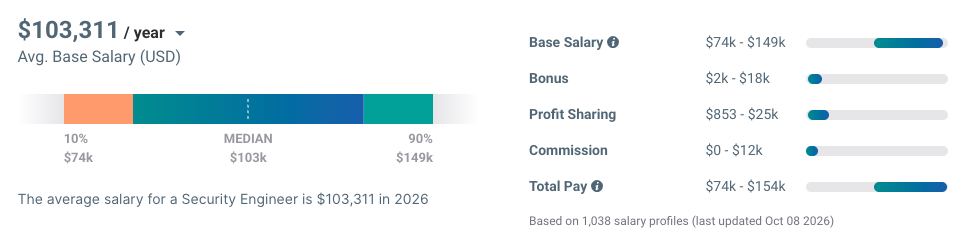
Security engineer salary in the United States

There is no official salary number that covers every security engineer title. These sources measure different groups:

SourceAnnual pay and scope
PayScale: Security Engineer$103,272 average base salary; 1,257 profiles.
PayScale: Cyber Security Engineer$107,852 average base salary; 1,426 profiles.
Salary.com: Cyber Security Engineer$136,847 estimated average annual salary.

These are not entry-level guarantees. Pay changes with experience, location, employer, and specialty. Do not combine the figures into a new average.

Job outlook

BLS does not publish a forecast just for jobs titled security engineer. For the broader information security analyst occupation, BLS reports a $129,180 median wage in May 2025 and projects 21% employment growth from 2025 to 2035. These are broader-occupation statistics, not direct measures of security engineer pay or growth.

Frequently asked questions

What is a security engineer?

Someone who builds, tests and maintains technology that helps protect computer systems and information.

What does a security engineer do each day?

The work may include fixing unsafe settings, reviewing weaknesses, configuring security tools, writing scripts and collaborating with IT or development teams.

How do I start a security engineering career?

Learn networking and systems, get practical experience, build small projects you can explain and apply to roles suited to your skills.

What is the job outlook for security engineers?

There is no separate BLS forecast for that exact title. BLS projects 21% growth for the broader information security analyst occupation from 2025 to 2035.

What skills matter most?

Networking, operating systems, access controls, troubleshooting and clear communication. Cloud technology and scripting are also useful in many roles.

Can you become a security engineer without a degree?

Yes, some employers consider equivalent technical experience, while others require a degree. Projects, work samples, and relevant experience can help demonstrate your technical skills.

References

  • O*NET | Information Security Engineers | Accessed October 2026
  • BLS | Information Security Analysts | Accessed October 2026
  • PayScale | Security Engineer | Accessed October 2026
  • PayScale | Cyber Security Engineer | Accessed October 2026
  • Salary.com | Cyber Security Engineer | Accessed October 2026
  • ISC2 | CISSP experience requirements | Accessed October 2026
  • AWS | Security – Specialty | Accessed October 2026

Primary Sidebar

Why readers trust Cybersecurity Guide

Community icon

500,000+ annual visitors rely on Cybersecurity Guide

Accountability icon

750+ cybersecurity degree programs reviewed

Communication icon

80+ expert contributors across academia and industry

Career icon

50+ free career, education, and planning guides

  • Online Programs
    • Master’s
    • Bachelor’s
    • Bootcamps & Certificates
Sponsored Ad
cybersecurityguide.org is an advertising-supported site. Clicking in this box will show you programs related to your search from schools that compensate us. This compensation does not influence our school rankings, resource guides, or other information published on this site.
  • CERTIFICATIONS
    • Azure
    • CASP+
    • CCNA
    • CEH
    • CISA
    • CISM
    • CISSP
    • CRISC
    • Cryptography
    • CTIA
    • CND
    • Forensics
    • Malware Analyst
    • OSCP
    • Pen Testing
    • Security+
  • CAREERS
    • Security Engineer
    • Chief Information Security Officer
    • Security Analyst
    • Computer Forensics
    • Security Consultant
    • Digital Forensics
    • Cryptographer
    • Security Administrator
    • Penetration Tester
    • Security Software Developer
    • Security Specialist
    • Security Code Auditor
    • Security Architect
    • Malware Analyst
    • Data Protection Officer
    • Cybercrime Investigator
    • Cryptanalyst
    • Security Incident Responder
    • Chief Privacy Officer
    • Risk Manager
    • Network Administrator
    • Business InfoSec Officer
    • Information Security Manager
    • Cyber Operations Specialist
  • RESOURCE CENTER
    • Women in Workforce Statistics
    • Centers for Academic Excellence
    • Job Guide
    • Veteran’s Guide
    • Women’s Guide
    • Internship Guide
    • Security Clearance Guide
    • Ethical Hacker Guide
    • Coding for Cybersecurity Guide
    • Cybersecurity 101
    • Student Guide to Internet Safety
    • Scholarship Guide
    • Cybersecurity Math Guide
    • Small Business Guide
    • Cybersecurity for K-12 Students
    • Career Networking Guide
    • What is a Cyber Range?
    • Code Like a Hacker
    • Reacting to a Cyber Incident
    • Introduction to Cyber Defense
    • Cybersecurity Courses Online
    • Recommended Reading
    • Phishing Attacks
    • Cybersecurity Responsibility
    • How to Get Into Cybersecurity
    • Cyberwarfare
    • Cybersecurity Insurance
    • Job Interview Prep
    • Readiness Economy
    • Is Cyber a Good Career?
    • What is CyberCorps?
    • DEI in Cyber
    • NIST and Small Business
    • Cybersecurity Without a Degree
    • Cybersecurity Skills Gap in AI
    • Cybersecurity Apprenticeship
    • Top Cybersecurity Companies
  • RESEARCH
    • AI and Cybersecurity
    • Holiday Hacks
    • Jobs Report
  • INDUSTRIES
    • Financial Sector
    • Insurance Sector
    • Healthcare Sector
    • Environmental Sector
    • Energy Sector
    • Government Sector
    • Transportation Sector
    • Food and Agriculture Sector
Cybersecurity Guide
  • Home
  • Campus Programs
  • About Us
  • Popular Careers
  • Online Programs
  • Terms of Use
  • Resources
  • Programs By State
  • Privacy Policy

Copyright © 2026 · Cybersecurity Guide · All Rights Reserved