- Associate degree
- Bachelor’s degree
- Master’s degree
- Cybersecurity certifications
- Cybersecurity initiatives in WV
- FAQs
Students exploring a cybersecurity degree in West Virginia will find a range of college pathways aligned with employer demand across finance, defense contracting, insurance, and healthcare.
This page stays focused on degree and school options and references institutions only when they offer distinctive workforce partnerships, research activity, or specialized training initiatives.
How we keep this page current
We update this page using authoritative labor-market and workforce sources, including CyberSeek’s state heat map for job-opening signals and methodology context, BLS OEWS state estimates for employment and wages, and West Virginia’s official cybersecurity office resources from the West Virginia Office of Technology.
Program- and initiative-level claims are verified against official institutional or state pages (for example, WVU and state-agency pages). Time-sensitive claims are reviewed periodically and revised or removed when they can’t be re-verified.
Ad
cybersecurityguide.org is an advertising-supported site. Clicking in this box will show you programs related to your search from schools that compensate us. This compensation does not influence our school rankings, resource guides, or other information published on this site.
Featured Cybersecurity Degree Programs
| School Name | Program | More Info |
|---|---|---|
| Salem University | Online BS in Information Technology (BSIT) - Cybersecurity | website |
| Salem University | Online MS in Information Technology (MSIT) - Cybersecurity | website |
| Southern New Hampshire University | Online BS in Cybersecurity or Online MS in Cybersecurity | website |
| UC Berkeley School of Information | Master’s in Cybersecurity | No GRE/GMAT Required | website |
| University of Maryland Global Campus | Online BS in Cyber Operations or Online BS in Cybersecurity Management & Policy | website |
Cybersecurity workforce demand in West Virginia
Cybersecurity demand is commonly tracked in two different ways: (1) online job postings (which reflect hiring activity and can fluctuate month-to-month), and (2) employment and wage estimates (which measure jobs currently employed and compensation, but don’t capture all job-posting dynamics).
- Online job-opening signals (postings): CyberSeek’s “Cybersecurity Supply/Demand Heat Map” reports total online job openings and other indicators at the state level, based on job postings and related labor-market data.
A recent West Virginia education policy document citing the CyberSeek heat map reported 647 open cybersecurity positions in West Virginia. - Employment + wages (BLS OEWS): In West Virginia, BLS OEWS estimates 210 employed Information Security Analysts and reports an annual mean wage of $96,360 for that occupation.
- A cyber-adjacent projection signal (state trends): For broader context on cyber-adjacent tech hiring pipelines, O*NET’s state trends for Software Developers in West Virginia include projected employment and annual openings estimates for the state.
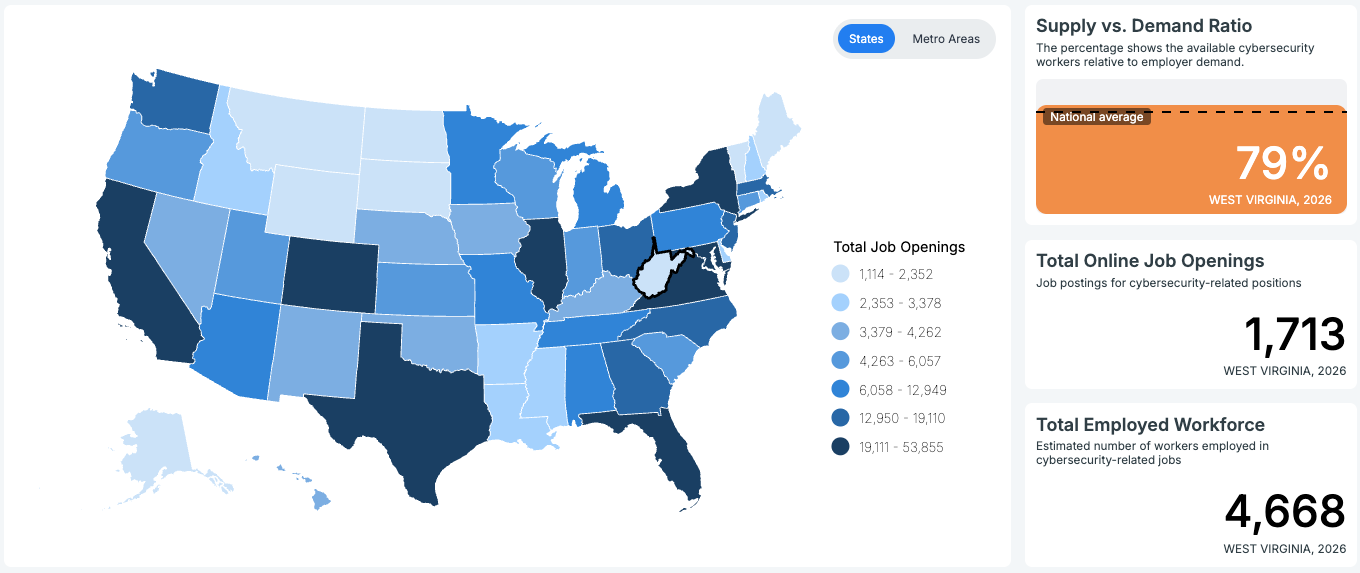
How to interpret these metrics: postings-based measures (like CyberSeek) are a real-time signal of employer demand but can overcount duplicates, vary by classification, and reflect short-term cycles; OEWS employment and wages are standardized estimates of people employed in an occupation, but don’t directly measure vacancies or near-term hiring spikes.
Related resources
Cybersecurity degree pathways in West Virginia
Associate degrees
An associate degree can be a practical starting point if you want to enter IT or security support roles sooner, then ladder into a bachelor’s later.
Blue Ridge Community and Technical College
Martinsburg, West Virginia Program: A.A.S. in Cyber Security
CAE designation: CAE-CD
Credits: 60
Cost per credit: $181 in-state | $327 out of state
Delivery method: Campus
Learn more: Program detailsBridgeValley Community & Technical College
South Charleston, West VirginiaProgram: Associate of Applied Science in Cyber Security and Networking Technology
Credits: 60
Cost per credit: $195 in state | $495 out of state
Delivery method: Campus
Learn more: Program detailsValley College-Princeton
Princeton, Martinsburg , and Beckley, West VirginiaProgram: Cybersecurity Associate’s Degree – Online
Credits: 65
Cost per credit: $975
Delivery method: Online
Learn more: Program detailsWest Virginia Northern Community College
Wheeling, West VirginiaProgram: A.A.S. in Cyber Security
Credits: 60
Cost per credit: $155 in-state | $496 out of state
Delivery method: Campus & online
Learn more: Program detailsWest Virginia University, Potomac State College
Keyser, West VirginiaProgram: Computer Information Systems, A.A.S.
Credits: 60
Cost per credit: $210 in-state | $526 out of state
Delivery method: Campus
Learn more: Program details
When comparing programs, look for:
- partnerships that provide internships or work-based learning
- hands-on lab requirements (virtual labs, networking labs, blue-team tooling)
- clear alignment to certifications (e.g., Security+, Network+), and
Bachelor’s degrees
A bachelor’s degree is the most common pathway for analyst and engineering-track roles and typically blends networking, systems, secure software, governance/risk, and hands-on security labs.
American Military University
Charles Town, West VirginiaProgram: Bachelor of Science in Cybersecurity
Credits: 120
Cost per credit: $325
Delivery method: Online
Learn more: Program detailsFairmont State University
Fairmont, West VirginiaProgram: Computer Science, Cybersecurity Concentration, B.S.
Credits: 120
Cost per credit: $342 in state | $755 out of state
Delivery method: Campus
Learn more: Program detailsMarshall University
Huntington, West VirginiaProgram: Bachelor of Science in Digital Forensics and Information Assurance
Credits: 120
Cost per credit: $359 in-state | $820 out-of-state
Delivery method: Campus
Learn more: Program detailsUniversity of Charleston
Charleston, West VirginiaProgram: Bachelor’s of Science in Cyber Security
Credits: 120
Cost per credit: $380
Delivery method: Online
Learn more: Program details
Distinctive, verifiable initiatives in West Virginia include:
- West Virginia University (WVU): Cybersecurity degree + cyber range development. WVU lists a dedicated Cybersecurity, BS program and has documented efforts to build a cybersecurity education and training facility/cyber range.
- WVU Cyber labs and facilities: WVU’s WVU Cyber site describes cybersecurity labs and facilities used to support hands-on learning and applied work.
West Virginia State University: Cybersecurity Innovation Center (CIC). WV State describes a Cybersecurity Innovation Center focused on cybersecurity education/collaboration.
Master’s degrees
A master’s can be a good fit if you already have a technical bachelor’s (CS/IT/engineering) or relevant experience and want advanced depth in security engineering, governance/risk, incident response, or research-oriented work.
American Public University System
Charles Town, West VirginiaProgram: Master of Science in Cybersecurity Studies (MS)
CAE designation: CAE-CD
Credits: 36
Cost per credit: $425
Delivery Method: Online
GRE/GMAT Required: Not Required
Learn more: Program detailsUniversity of Charleston
Charleston, West VirginiaProgram: Online Master of Science in Cybersecurity
Credits: 30
Cost per credit: $425
Delivery Method: Online
Learn more: Program details
When evaluating master’s options, prioritize:
- alignment with your target role (GRC vs. engineering vs. threat intel/DFIR)
- evidence of applied labs/clinics/projects,
- employer engagement and internship pipelines, and
Certifications and workforce programs
If you’re aiming for a faster on-ramp—or want to pair credentials with a degree—certifications and structured short-term training can be valuable. In West Virginia, examples of state-anchored workforce training initiatives include:
- West Virginia Office of Technology (WVOT) Cyber Security: WVOT describes cybersecurity responsibilities and programs within the state government, including training and awareness, vulnerability management, and other cyber operations functions.
- State partnership programs (historical example): West Virginia announced a cybersecurity training partnership with SANS (including GirlsGoCyberStart) as part of state workforce outreach (not a degree program, but relevant to early pipeline exposure).
- WV Local and State Government Cybersecurity Partnering (WVNET-linked): WVNET-hosted workshop resources describe cybersecurity partnering workshops involving state/local stakeholders.
Blue Ridge Community and Technical College
Martinsburg, West VirginiaProgram: Information Security Certificate
CAE designation: CAE-CD
Credits: 30
Cost per credit: $181 in state | $327 out of state
Delivery Method: Campus, Hybrid, Online
Learn more: Program details
Scholarship for Service
As of the U.S. Office of Personnel Management (OPM) CyberCorps®: Scholarship for Service participating-institutions list, West Virginia does not appear to have an in-state participating institution listed. If this changes, it will be reflected on OPM’s official institution list.
Unique state cybersecurity initiatives
- West Virginia Cybersecurity Office (state government): West Virginia’s Cybersecurity Office operates within the West Virginia Office of Technology and is referenced in state government materials and statute-related documents.
- WVU cybersecurity range and labs (higher-ed training infrastructure): WVU has publicly documented cybersecurity range development and lab facilities intended to support hands-on learning.
- WVNET-linked cybersecurity partnering workshops (public-sector engagement): WVNET-linked materials describe cybersecurity partnering workshops aimed at state/local government stakeholders.
Frequently asked questions about cybersecurity degrees in West Virginia
There isn’t a single perfect “cybersecurity jobs” count because cyber work spans multiple occupations. One clean benchmark is BLS OEWS for Information Security Analysts, which estimates 210 employed in West Virginia (May 2023).
BLS OEWS reports an annual mean wage of $96,360 for Information Security Analysts in West Virginia.
CyberSeek’s heat map is designed to show online job openings, employed workforce estimates, and supply/demand ratios at the state level, which are commonly used as demand signals.
“Best” depends on your target role. For analyst/engineering tracks, a bachelor’s in cybersecurity (or closely related IT/CS degree with security concentration) is the most common route; prioritize programs with hands-on labs/cyber ranges and employer engagement. WVU’s cybersecurity degree and cyber range/lab investments are examples of the kind of hands-on infrastructure to look for.
Many West Virginia institutions offer online options or hybrid formats, but availability changes frequently. The most reliable approach is to verify the delivery format directly on the official program page for each school.
West Virginia has had state-supported training and outreach efforts (for example, a state-announced partnership involving SANS programming). For current bootcamps, verify with the training provider or state workforce partners.
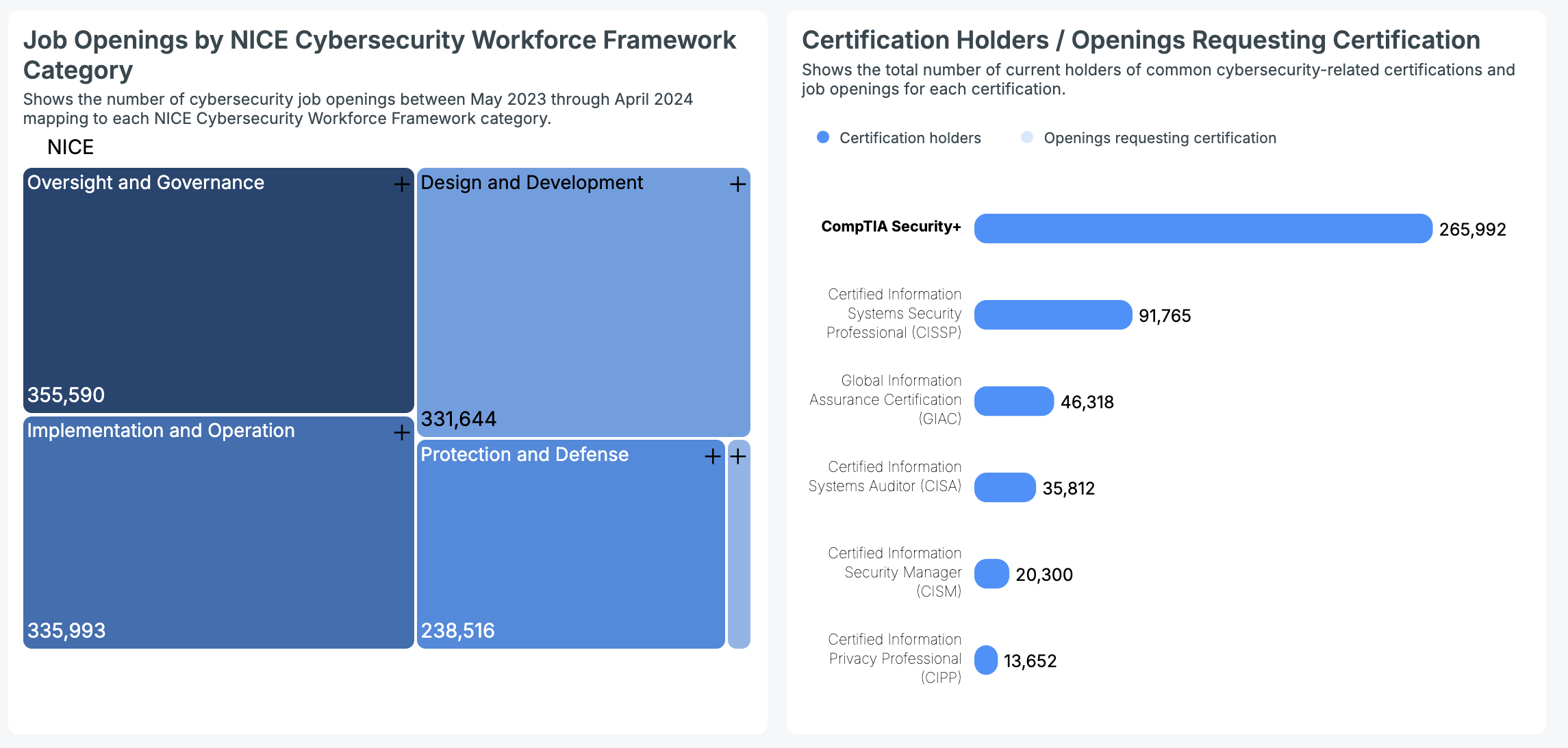
CyberSeek includes a “certification holders/openings requesting certification” feature within its heat map tool, but the specific “most requested” list is dynamic and can vary by timeframe and filters. Use CyberSeek’s state heat map filters to review the current West Virginia snapshot.
Yes. An associate degree can be a good entry point into IT support, networking, and junior security-adjacent roles—especially if you pair it with labs, internships, and early certifications. (Plan a pathway to a bachelor’s if you’re targeting analyst roles that commonly require four-year credentials.)
Typical timelines: associate (2 years), bachelor’s (4 years), master’s (1–2 years) depending on prerequisites and whether you attend full-time.
As of OPM’s official list of participating institutions, no West Virginia institution is listed.
Cybersecurity hiring spans government, education, healthcare, financial services, and critical infrastructure organizations. West Virginia’s government cybersecurity function is anchored in the WV Office of Technology, and statewide public-sector partnering efforts are reflected in WVNET-linked materials.
Entry-level opportunities often appear as SOC support, IT security support, vulnerability management support, or IT/networking roles that lead into security. CyberSeek’s state heat map is a practical way to monitor current posting volume and role titles in West Virginia.
Look for cyber ranges and dedicated security labs that support realistic practice environments. WVU has publicly described cyber range development and maintains a labs-and-facilities page for hands-on learning infrastructure.
Sources
- U.S. Bureau of Labor Statistics | State Occupational Employment and Wage Estimates: West Virginia | Accessed March 5, 2026
- CyberSeek | Cybersecurity Supply/Demand Heat Map | Accessed March 5, 2026
- CyberSeek | CyberSeek homepage/insights context | Accessed March 5, 2026
- West Virginia Office of Technology (WVOT) | Cyber Security | Accessed March 5, 2026
- West Virginia Legislature / Legislative Auditor | The West Virginia Office of Technology | Accessed March 5, 2026
- West Virginia University | WVU Cyber: Labs and Facilities | Accessed March 5, 2026
- U.S. Office of Personnel Management (OPM) | CyberCorps®: Scholarship for Service | Accessed March 5, 2026
- West Virginia State University | Cybersecurity Innovation Center | Accessed March 5, 2026
- West Virginia Department of Administration | West Virginia Partners with SANS Institute to Offer Cybersecurity Training | Accessed March 5, 2026
- WV Cybersecurity Partnering (WVNET-linked) | WV Local and State Government CyberSecurity Partnering | Accessed March 5, 2026
- WVHEPC — West Virginia Network (WVNET) | Accessed March 5, 2026
- O*NET OnLine — West Virginia trends: Software Developers | Accessed March 5, 2026