- Associate degrees
- Bachelor’s degrees
- Master’s degrees
- Cybersecurity certifications
- Nevada Cybersecurity initiatives
- FAQs
Students pursuing a cybersecurity degree in Nevada can choose from a range of academic pathways including associate, bachelor’s, and graduate-level programs offered through colleges and universities.
This guide emphasizes degree and school pathways and references institutions only when they offer distinctive workforce partnerships, research initiatives, or training environments beyond a standard degree listing.
Ad
cybersecurityguide.org is an advertising-supported site. Clicking in this box will show you programs related to your search from schools that compensate us. This compensation does not influence our school rankings, resource guides, or other information published on this site.
Featured Cybersecurity Degree Programs
| School Name | Program | More Info |
|---|---|---|
| Eastern Oregon University | Online BS in Cybersecurity | website |
| Southern New Hampshire University | Online BS in Cybersecurity or Online MS in Cybersecurity | website |
| UC Berkeley School of Information | Master’s in Cybersecurity | No GRE/GMAT Required | website |
| Purdue Global | Online BS in Cybersecurity | website |
How we keep this page current
This page is updated regularly using authoritative labor market and education sources, including CyberSeek, the Bureau of Labor Statistics, the Nevada Labor Market Information System, the Nevada Office of the Chief Information Officer, and the NSF Scholarship for Service program. Institutional initiatives are verified against official university and state program pages before inclusion.
The page is reviewed periodically to ensure time-sensitive claims are updated or removed and that program information reflects current offerings.
Cybersecurity workforce demand in Nevada
Employer demand for cybersecurity professionals in Nevada remains steady across sectors, including gaming, healthcare, finance, and government.
According to CyberSeek, Nevada typically reports several thousand cybersecurity job postings annually, reflecting sustained employer demand for information security analysts, security engineers, and related roles. CyberSeek data measures employer job postings and certifications requested, which indicates hiring demand but does not represent total employment.
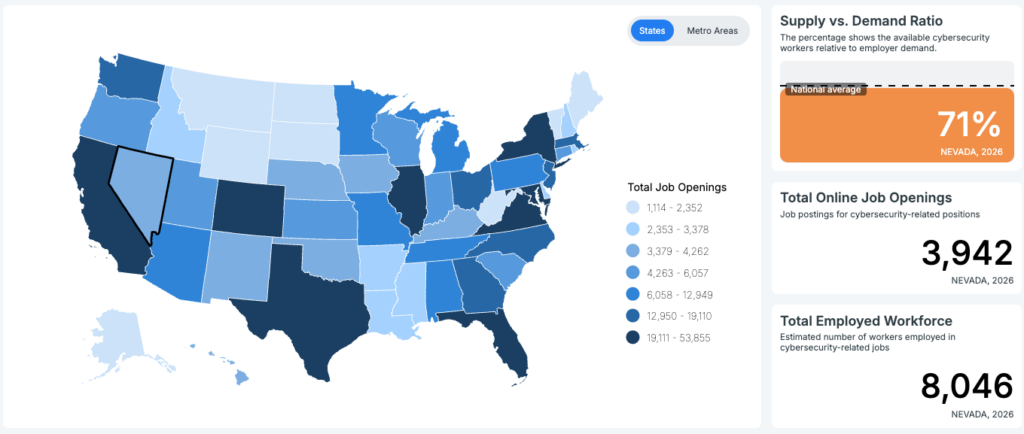
State labor projections show continued growth in cybersecurity-related occupations. The Nevada Department of Employment, Training and Rehabilitation projects strong long-term demand for information security professionals across the state workforce. These projections represent expected employment growth rather than current openings.
According to the Bureau of Labor Statistics, Information Security Analysts in Nevada earn a mean annual wage of about $107,000, with employment concentrated in the Las Vegas and Reno metropolitan areas. BLS employment estimates measure the number of people working in a field rather than the demand for hiring.
Together, CyberSeek demand signals, state projections, and BLS wage estimates suggest consistent employer need for trained cybersecurity professionals in Nevada.
Related resources
Cybersecurity degree pathways in Nevada
Nevada offers multiple educational pathways into cybersecurity careers. Students can begin with short-term workforce training or pursue advanced graduate study depending on career goals.
Associate degrees
Associate degrees provide a foundational entry point into cybersecurity and IT support roles. Programs typically include coursework in:
- Network security fundamentals
- Operating systems
- Cyber defense basics
- Ethical hacking fundamentals
- Security administration
Students considering associate degrees should look for programs that:
- Align with industry certifications such as Security+ or Network+
- Offer transfer agreements into bachelor’s programs
- Include hands-on lab work or virtual environments
Community college pathways can provide a lower-cost entry into cybersecurity education and often allow transfer into four-year degree programs.
College of Southern Nevada
Las Vegas, Nevada Program: Associate of Applied Science in Computing & Information Technology – Cyber Security – Network Security
CAE designation: CAE-CD
Credits: 60
Cost per credit: $265 in state | $872 out of state
Delivery method: Campus & online
Learn more: Program detailsTruckee Meadows Community College
Reno, NevadaProgram: Associate of Applied Science in Computer Information Technology – Cyber Security Emphasis
Credits: 60
Cost per credit: $141 in-state | $411 out of state
Delivery method: Campus
Learn more: Program details
Bachelor’s degrees
A bachelor’s degree is the most common entry-level credential for cybersecurity professionals. Nevada bachelor’s programs typically include coursework in:
- Secure software development
- Network defense
- Digital forensics
- Risk management
- Cloud security
- Security architecture
University of Nevada-Reno
Reno, NevadaProgram: Cyber Security Minor
CAE designation: CAE-CD
Credits: 122
Cost per credit: $258 in-state | $814 out-of-state
Delivery method: Campus
Learn more: Program details
Students evaluating bachelor’s programs should look for:
- Designation as a National Center of Academic Excellence in Cyber Defense institution
- Dedicated cybersecurity labs or cyber ranges
- Internship or employer partnership opportunities
- Integration of certification preparation into coursework
The University of Nevada Las Vegas Cybersecurity Center supports cybersecurity education and research through interdisciplinary programs, student research opportunities, and industry partnerships.
The University of Nevada Reno Cybersecurity Center supports workforce development and applied cybersecurity research and collaborates with government and industry partners across the region.
These types of applied initiatives provide students with opportunities beyond standard classroom instruction.
Master’s degrees
Master’s-level cybersecurity degrees support advancement into specialized or leadership roles such as:
- Security architect
- Cybersecurity manager
- Threat intelligence analyst
- Security engineer
Graduate programs often include advanced coursework in:
- Applied cryptography
- Secure systems design
- Incident response
- Cyber risk management
- Security analytics
Students considering graduate programs should evaluate:
- Research opportunities
- Industry partnerships
- Flexible or online delivery formats
- Thesis or applied capstone options
Graduate-level programs are particularly useful for professionals transitioning into cybersecurity from other technical fields.
University of Nevada, Las Vegas
Las Vegas, NevadaProgram: Master of Science – Cybersecurity
CAE designation: CAE-CD
Credits: 30
Cost per credit: $460 in-state | $1,563 out of state
Delivery method: Campus & online
Learn more: Program detailsUniversity of Nevada-Reno
Reno, NevadaProgram: Online M.S. in Cybersecurity
CAE designation: CAE-CD
Credits: 30
Cost per credit: 650
Delivery method: Online
GRE Requirement: Not required
Learn more: Program details
Certifications and workforce programs
Short-term cybersecurity training programs can provide rapid entry into entry-level roles or support career transitions.
Workforce-oriented programs often include:
- Certification-focused training
- Hands-on labs
- Virtual cyber ranges
- Employer-aligned curriculum
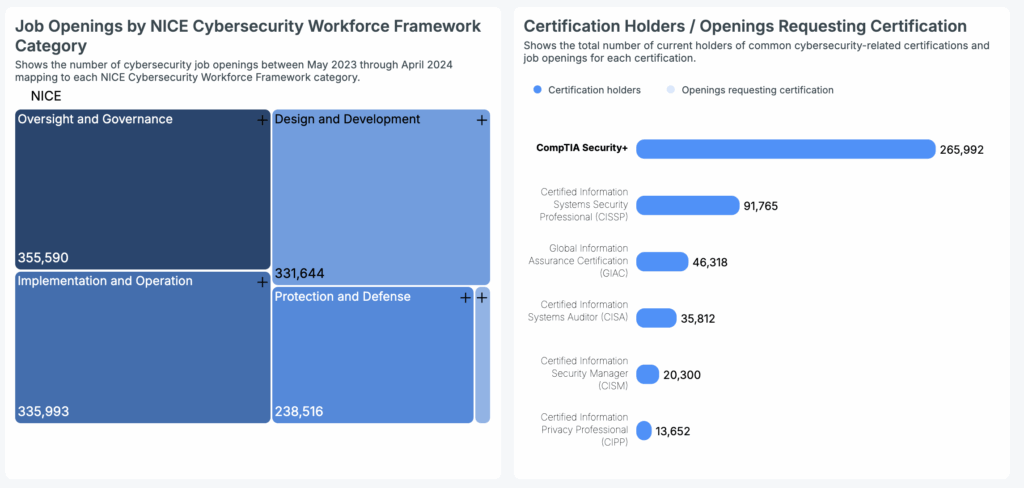
Common certifications requested by employers include:
- CompTIA Security+
- Certified Information Systems Security Professional (CISSP)
- Certified Ethical Hacker (CEH)
College of Southern Nevada
Las Vegas, NevadaProgram: Certificate of Achievement in Computing & Information Technology – Cyber Security – Digital Forensics
CAE designation: CAE-CD
Credits: 33
Cost per credit: $116 in state | $579 out of state
Delivery method: Campus
Learn more: Program detailsUniversity of Nevada, Las Vegas
Las Vegas, NevadaProgram: Graduate Certificate in Cybersecurity
CAE designation: CAE-CD
Credits: 12
Cost per credit: $322 in-state | $676 out of state
Delivery method: Campus
Learn more: Program detailsUniversity of Nevada-Reno
Reno, NevadaProgram: Graduate Certificate in Cyber Security
CAE designation: CAE-CD
Credits: 12
Cost per credit: $322 in-state | $676 out of state
Delivery method: Campus
Learn more: Program details
Certification demand data from CyberSeek shows Security+ and CISSP among the most requested credentials nationally and regionally.
These programs are often offered through colleges, workforce development agencies, and continuing education divisions.
Scholarship for Service
Nevada institutions participate in the federal Scholarship for Service program, which provides scholarships in exchange for cybersecurity service in government roles after graduation.
Scholarship for Service programs typically include:
- Full tuition support
- Living stipends
- Professional development
- Internship placements
Participation varies by funding cycle, and students should verify current availability through the NSF Scholarship for Service program directory.
Unique Nevada cybersecurity initiatives
Nevada supports cybersecurity workforce development through a combination of state initiatives and university partnerships.
The State of Nevada Office of the Chief Information Officer coordinates cybersecurity policies and workforce initiatives across state agencies and public institutions.
The Nevada System of Higher Education collaborates with state agencies and employers to support workforce training aligned with high-demand occupations, including cybersecurity.
University-based cybersecurity centers in Reno and Las Vegas provide research partnerships, workforce development, and student training opportunities that extend beyond traditional degree programs.
These initiatives help align cybersecurity education programs with state workforce needs.
Frequently asked questions about cybersecurity degrees in Nevada
CyberSeek reports thousands of cybersecurity job postings annually in Nevada, indicating sustained employer demand for trained professionals. Job posting data reflects hiring demand rather than total employment.
Information Security Analysts in Nevada earn a mean annual wage of about $107,000, according to the Bureau of Labor Statistics.
Most cybersecurity professionals begin with a bachelor’s degree covering network security, risk management, and digital forensics. Programs with applied labs, internships, and employer partnerships typically provide the strongest preparation.
Yes. Many Nevada institutions offer online or hybrid cybersecurity degree options. Students should confirm delivery format and residency requirements directly with institutions.
Yes. Short-term workforce training programs are available through colleges and workforce development organizations and often focus on certification preparation and hands-on labs.
CyberSeek data shows common certifications include:
– CompTIA Security+
– CISSP
– Certified Ethical Hacker (CEH)
These certifications appear frequently in cybersecurity job postings.
Yes. CyberSeek job-posting data and Nevada labor projections both indicate sustained demand for cybersecurity professionals.
Yes. Associate degrees can lead to entry-level roles such as:
– IT support specialist
– Security technician
– Network support specialist
Many associate programs transfer into bachelor’s degrees.
Typical timelines include:
– Associate degree: about 2 years
– Bachelor’s degree: about 4 years
– Master’s degree: about 1–2 years
Part-time and online options may take longer.
Yes. Nevada institutions periodically participate in the federal Scholarship for Service program, which funds cybersecurity education in exchange for government service after graduation.
Cybersecurity graduates in Nevada commonly work in:
– Gaming and hospitality
– Healthcare
– Financial services
– Technology services
– Government agencies
These industries rely on cybersecurity professionals to protect sensitive data and infrastructure.
Yes. Entry-level cybersecurity roles include:
– Security analyst
– SOC analyst
– IT security specialist
– Network security technician
Many employers expect foundational certifications and hands-on experience in addition to a degree.
Sources
- CyberSeek | Cybersecurity Supply/Demand Heat Map | Accessed February 26, 2026
- Bureau of Labor Statistics | Occupational Employment and Wage Statistics | Accessed February 26, 2026
- Nevada Department of Employment, Training and Rehabilitation | Nevada Workforce Labor Market Data | Accessed February 26, 2026
- Nevada Office of the Chief Information Officer | State Cybersecurity Programs | Accessed February 26, 2026
- University of Nevada Las Vegas | Cybersecurity Center | Accessed February 26, 2026
- University of Nevada Reno | Cybersecurity Center | Accessed February 26, 2026
- NSF / OPM | CyberCorps Scholarship for Service | Accessed February 26, 2026
- Nevada System of Higher Education | Workforce Development Initiatives | Accessed February 26, 2026