- Associate degree
- Bachelor’s degree
- Master’s degree
- Cybersecurity certifications
- Cybersecurity initiatives in WA
- FAQs
For students comparing cybersecurity education options, Washington includes several college pathways linked to workforce demand in major industries such as finance, defense contracting, insurance, and healthcare.
Any program or initiative claims about institutions are verified against official university or state pages. We periodically review this page and remove or revise time-sensitive claims that can’t be re-verified.
How we keep this page current
This page is updated using CyberSeek for state-level demand signals, BLS for statewide wage and employment estimates, Washington’s state labor-market resources (including CareerBridge and Employment Security Department materials), Washington’s state cybersecurity office, and NSF CyberCorps®: Scholarship for Service (SFS) participation listings.
Program and initiative claims are verified against official institutional or state pages. The page is reviewed periodically and time-sensitive claims are updated or removed.
Ad
cybersecurityguide.org is an advertising-supported site. Clicking in this box will show you programs related to your search from schools that compensate us. This compensation does not influence our school rankings, resource guides, or other information published on this site.
Featured Cybersecurity Degree Programs
| School Name | Program | More Info |
|---|---|---|
| Eastern Oregon University | Online BS in Cybersecurity | website |
| Southern New Hampshire University | Online BS in Cybersecurity or Online MS in Cybersecurity | website |
| UC Berkeley School of Information | Master’s in Cybersecurity | No GRE/GMAT Required | website |
| Purdue Global | Online BS in Cybersecurity | website |
Related resources
Cybersecurity workforce demand in Washington State
CyberSeek provides a Washington State view of cybersecurity demand using online job postings and supply/demand indicators (a demand signal, not an official employment count).
Washington’s state career and labor-market portal CareerBridge reports 5,049 workers in Information Security Analysts (SOC 15-1212) in Washington and 885 openings per year.
For standardized wage and employment estimates, BLS OEWS reports that Washington employed 4,940 Information Security Analysts with an annual mean wage of $148,090. As a cyber-adjacent comparison point, BLS also reports Washington employment and wages for Computer Network Support Specialists, a role that can be part of an IT-to-security pathway.
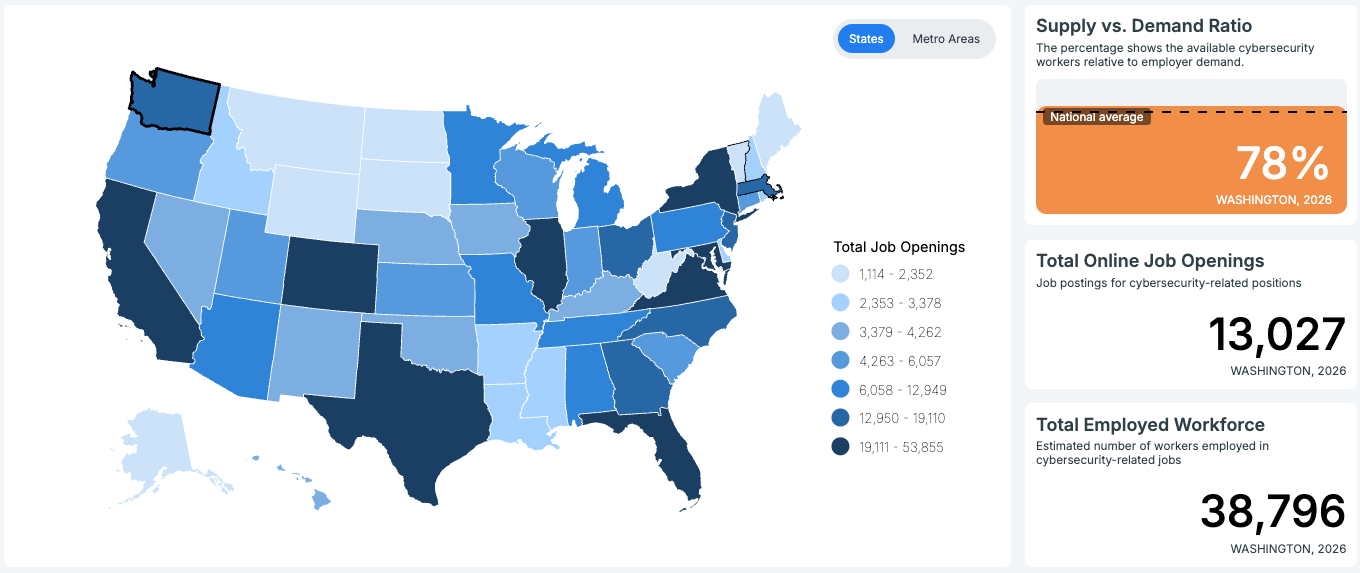
What these metrics do (and don’t) mean: CyberSeek reflects online posting activity (hiring signals), BLS OEWS reflects employment and wages (filled jobs and pay estimates), and CareerBridge provides state-reported career outlook/openings figures presented for jobseekers. These sources measure different things and shouldn’t be treated as interchangeable.
Cybersecurity degree pathways in Washington State
Washington State offers multiple entry points into cybersecurity. The best pathway depends on your timeline, prior experience, and whether you want quick workforce entry or deeper specialization.
Associate degrees
Associate degrees (often 2 years) can prepare students for entry-level IT and security-adjacent roles, especially when paired with certifications.
What to look for:
- Lab-based networking and systems coursework
- Security fundamentals aligned to common entry certifications (e.g., Security+)
- Clear transfer pathways into bachelor’s programs
Distinctive statewide support example: Washington’s Cybersecurity Center of Excellence (hosted at Whatcom Community College) describes statewide collaboration with industry and educators, supporting the training pipeline.
Columbia Basin College
Pasco, Washington Program: Cyber Security AAS
CAE designation: CAE-CD
Credits: 90-94
Cost per credit: $124 in state | $318 out of state
Delivery Method: Campus
Learn more: Program details
Bachelor’s degrees
Bachelor’s degrees (often 4 years) are a common credential for entry-level security analyst roles and can support progression into engineering, forensics, and governance.
What to look for:
- Hands-on security labs and realistic environments (virtualization, cloud, log analysis, incident response exercises)
- Internship pipelines and employer-engaged capstones
- Evidence of active cyber programming (centers, competitions, industry advisory engagement)
Campus-based bachelor’s degree
City University of Seattle
Seattle, WashingtonProgram: Bachelor of Science in Cybersecurity and Information Assurance
Credits: 180
Cost per credit: $495
Delivery Method: Campus, Online
Learn more: Program detailsUniversity of Washington-Seattle Campus
Seattle, WashingtonProgram: Bachelor of Science in Informatics – Information Assurance and Cybersecurity Option
CAE designation: CAE-CD, CAE-R
Credits: 180
Cost per credit: $272 in-state | 905 out-of-state
Delivery Method: Campus
Learn more: Program detailsWestern Washington University
Bellingham, WashingtonProgram: Bachelor of Science in Cybersecurity
CAE designation: CAE-CD
Credits: 180
Cost per credit: $172 in-state | $570 out-of-state
Delivery Method: Campus
Learn more: Program details
Online bachelor’s degree
City University of Seattle
Seattle, WashingtonProgram: Bachelor of Science in Cybersecurity and Information Assurance
Credits: 180
Cost per credit: $495
Delivery Method: Campus, Online
Learn more: Program details
Distinctive initiative example (statewide lab infrastructure):
The state’s Cybersecurity Center of Excellence describes Cyber Range Poulsbo as Washington’s educational cyber range supporting cybersecurity programs statewide. Western Washington University describes the Cyber Range Poulsbo as an educational resource for Washington. Students can also verify whether an institution participates in the NSA/DHS Centers of Academic Excellence in Cybersecurity network using the official directory.
Master’s degrees
Master’s programs (often 1–2 years) are commonly used by:
- IT professionals moving into security leadership or architecture
- Students targeting advanced technical areas (cloud security, forensics, applied research)
- Career changers with technical undergraduate backgrounds
Campus-based master’s degree
University of Washington – Tacoma Campus
Tacoma, WashingtonProgram: Master in Cybersecurity and Leadership (MCL)
Credits: 40
Cost per credit: $1,069 in-state | $1,795 out of state
Delivery Method: Campus, Online
GRE/GMAT Required: Not required
Learn more: Program details
Online master’s degree
City University of Seattle
Seattle, WashingtonProgram: Master of Science in Cybersecurity
CAE designation: CAE-CD
Credits: 59
Cost per credit: $735
Delivery Method: Online
GRE/GMAT Required: Not Required
Learn more: Program detailsUniversity of Washington – Tacoma Campus
Tacoma, WashingtonProgram: Master in Cybersecurity and Leadership (MCL)
Credits: 40
Cost per credit: $1,069 in-state | $1,795 out of state
Delivery Method: Campus, Online
GRE/GMAT Required: Not required
Learn more: Program details
Prioritize programs with:
- Documented partnerships with employers or government entities
- A capstone/practicum tied to real-world systems
- Applied labs, institutes, or cyber ranges that support advanced skill development
Certifications and workforce programs
Certificates and short-term programs can complement degrees, especially when aligned to employer expectations and role pathways. CyberSeek’s pathway tools can help students map roles to skills and certifications.
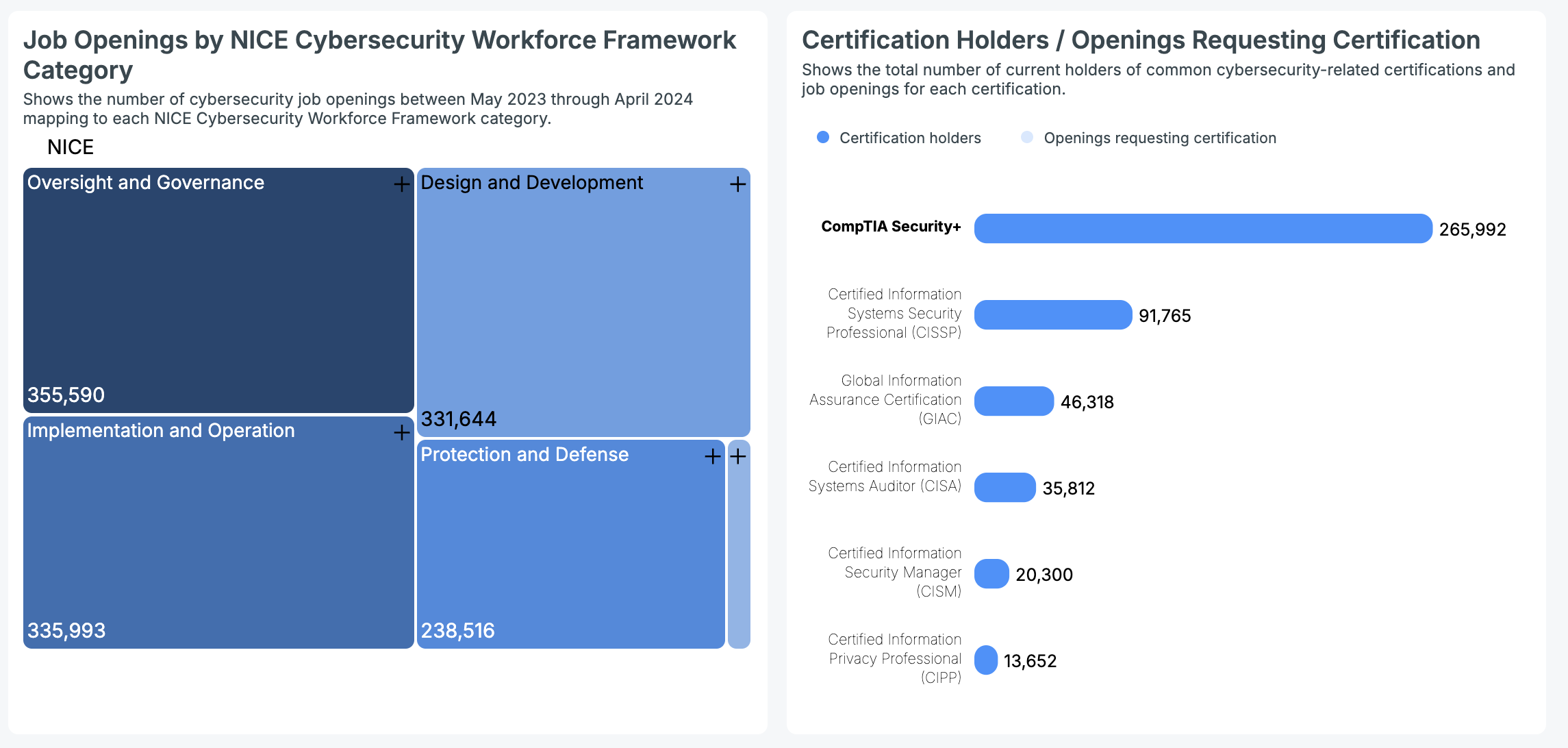
Washington also has a documented ecosystem of education-to-workforce support through the state’s Center of Excellence model (including cybersecurity), which can help students find training resources and connections.
Central Washington University
Ellensburg, WashingtonProgram: Certificate in Cybersecurity
Credits: 20
Cost per credit: $357 in state | $836 out of state
Delivery Method: Campus, Online
Learn more: Program detailsUniversity of Washington Continuum College
Seattle, WashingtonProgram: Certificate in Cyber Security
Credits: 12
Cost per credit: $350
Delivery Method: Online
Learn more: Program details
Scholarship for Service (SFS)
The NSF CyberCorps®: Scholarship for Service (SFS) program provides scholarships for cybersecurity students who commit to working in government after graduation. Washington State institutions listed in the SFS participating institutions directory include University of Washington – Tacoma (status shown on the directory) and Washington State University.WSU also publishes its SFS program information through its cybersecurity institute site.
Unique state cybersecurity initiatives
Washington’s statewide cybersecurity office is housed within Washington Technology Solutions (WaTech) through the State Office of Cybersecurity, which describes its mission and services for safeguarding state information assets.
WaTech also publishes Washington’s Enterprise IT Security Strategy (Security for 2025–2027), which is relevant to students interested in public-sector cybersecurity environments and workforce priorities.
Workforce-pipeline and education infrastructure initiatives with primary sources include:
- Washington’s Cybersecurity Center of Excellence (hosted at Whatcom Community College).
- Cyber Range Poulsbo is a statewide educational cyber range resource.
Frequently asked questions about cybersecurity degrees in Washington State
For a standardized occupation count, BLS reports 4,940 Information Security Analysts employed in Washington (May 2023).BLS OEWS Washington (May 2023). For a state career-portal view, CareerBridge reports 5,049 workers for the occupation in Washington (as shown on its occupation profile). These may differ due to methodology and update cycles.
BLS reports an annual mean wage of $148,090 for Information Security Analysts in Washington (May 2023).
There isn’t one universal “best.” A strong choice is the degree level that matches your target role plus hands-on practice (labs, internships, capstones). If you want statewide lab infrastructure, look for programs that leverage resources like the educational cyber range described by the state’s cybersecurity education partners.
Many Washington-serving institutions offer online or hybrid options, but formats change. Confirm delivery mode and accreditation on the institution’s official program pages.
Yes—short-term training options exist, and students should choose programs aligned to role pathways and skills employers signal. CyberSeek’s tools can help map roles and skill clusters before selecting a bootcamp or certificate.
Certification demand varies by employer and seniority. CyberSeek provides posting-based signals and pathway context that can help prioritize certifications by role.
CyberSeek demand indicators and state career outlook data both suggest ongoing hiring activity.
Yes. An associate degree can be an efficient entry point into IT and security-adjacent roles, especially when paired with certifications and a transfer plan into a bachelor’s program.
Typical timelines: associate (2 years), bachelor’s (4 years), master’s (1–2 years). Transfer credits and part-time enrollment can change the timeline.
Yes. Washington institutions appear in the official SFS participating institutions directory (including the entries shown for Washington).
Cybersecurity graduates are hired across government, cloud/technology, healthcare, finance, education, and manufacturing. Students interested in public-sector cybersecurity should review WaTech’s statewide cybersecurity role and published strategy.
Yes. Entry-level roles often include SOC analyst, junior security analyst, and IT security specialist. CyberSeek’s pathway tools can help map entry roles and progression.
Sources
- CyberSeek | Cybersecurity Supply/Demand Heat Map | Accessed March 3, 2026
- U.S. Bureau of Labor Statistics (BLS) | Occupational Employment and Wage Statistics: Washington | Accessed March 3, 2026
- Washington CareerBridge | Information Security Analysts | Accessed March 3, 2026
- Washington Technology Solutions (WaTech) | State Office of Cybersecurity | Accessed March 3, 2026
- Washington Technology Solutions (WaTech) | Enterprise IT Security Strategy: Security for 2025–2027 |
- CAE Community | Centers of Academic Excellence institution map | Accessed March 3, 2026
- Washington State | Cybersecurity Center of Excellence | Accessed March 3, 2026
- Washington State Cybersecurity Center of Excellence | Cyber Range Poulsbo | Accessed March 3, 2026
- Western Washington University | About Cyber Range Poulsbo | Accessed March 3, 2026
- CyberCorps®: Scholarship for Service (OPM/NSF) | Program site | Accessed March 3, 2026
- CyberCorps®: Scholarship for Service (OPM/NSF) | Participating Institutions | Accessed March 3, 2026
- Washington State University | CySER CyberCorps: Scholarship for Service (SFS) | Accessed March 3, 2026